Government Gardens
Government Gardens
In the heart of Rotorua, Government Gardens brings together colonial architecture, Maori memorials and geothermal pools on former land gifted to the Crown in 1880.
In the heart of Rotorua, on the shores of the lake, Government Gardens occupies land gifted to the British Crown in 1880 by the Ngati Whakaue tribe. This public park blends colonial architecture, Maori memorials and visible geothermal activity across several dozen hectares, bordering Queens Drive.
Why visit Government Gardens?
The park concentrates several layers of Rotorua's history in one location: a former marshland used by Maoris for bird hunting, a thermal project launched by the New Zealand government in the late 19th century, and remarkable architectural heritage represented by the Bath House in Elizabethan Tudor style. Entry to the park is free, and visitors will find both commemorative monuments, Maori sculptures signed by Tene Waitere, manicured lawns, steaming pools and several bathing establishments still in operation.
For those interested in the encounter between Maori culture and British colonial heritage, this site offers a highly readable perspective on 20th-century New Zealand.
Site history
The place was once known by the Maori name Paepaehakumanu Motutara. It was a marshy area used by Maoris for bird hunting. In 1880, the Ngati Whakaue tribe ceded 50 acres to the British Crown, on the express condition that the land serve the public good. The government established the Sanatorium Reserve there, the embryo of the current thermal park.
Works of sanitation, drainage and planting gradually transformed the marshes into landscaped gardens. In 1908, the Bath House was inaugurated in Elizabethan Tudor style to welcome spa guests who came to benefit from the geothermal waters. The building today houses the Rotorua Museum, which was closed for renovation at the time of our last update.
In 1933, the Blue Baths complemented the thermal facilities. These pools, among the first to permit mixed bathing in the country, closed their doors in 1982 before being restored and reopened in 2000.
What to see on site?
The Bath House and Rotorua Museum
White façade with black timber framing, corner towers, English-style gardens in the foreground: the Bath House remains the most reproduced image of Rotorua. Even when closed for work, it photographs beautifully from the central avenue and serves as a visual landmark for navigating the park.
The Blue Baths
Mediterranean in style, the Blue Baths stand apart from the rest of the park's architecture through their bright arcades and outdoor swimming pool. The establishment operated as a leisure facility rather than a medicinal bath, which marked a departure from classical thermal bathing at the time.
Maori memorials and sculptures
- Arawa Soldiers Memorial: erected in 1927 in tribute to Maori warriors who fell during the First World War. Its iconography evokes the arrival of the Arawa canoe at Maketu, as well as Rangitihi, ancestor of the local tribes, and his eight children.
- Fred Wylie Memorial: dedicated to this soldier who fell during the Boer Wars.
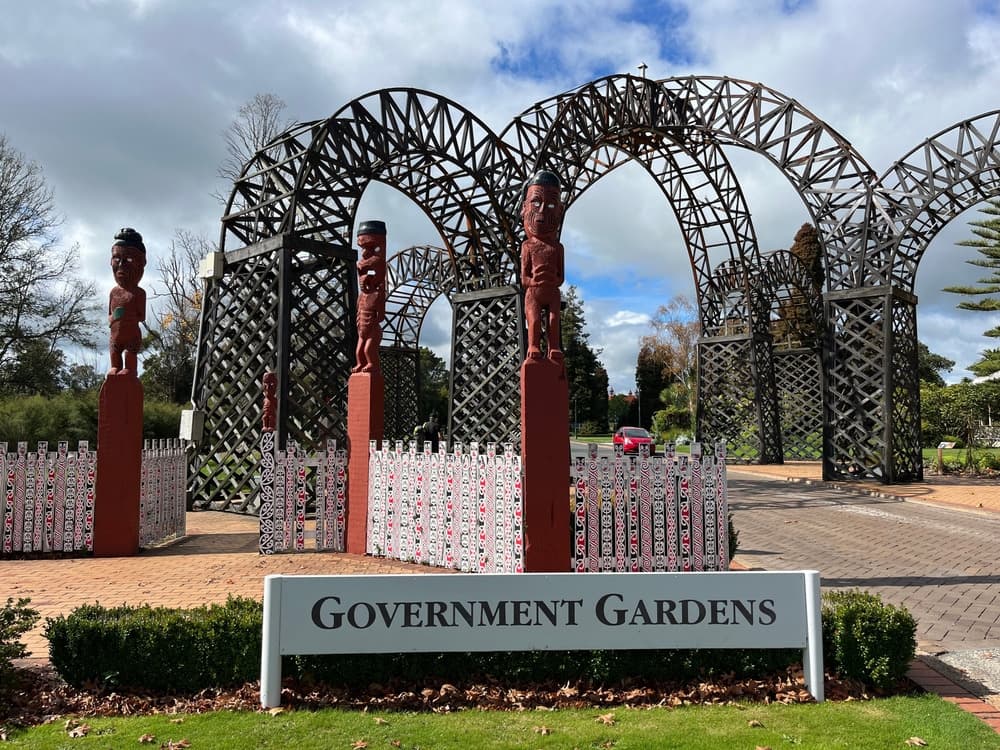
- Prince's Arch: wooden arch carved in 1901 for the visit of the Duke and Duchess of Cornwall and York. Designed by Captain A. C. Turner and built by Alfred Warbrick, it stands at the western entrance.
- Red pou: these carved posts are the work of Tene Waitere, created in 1907.
Other amenities
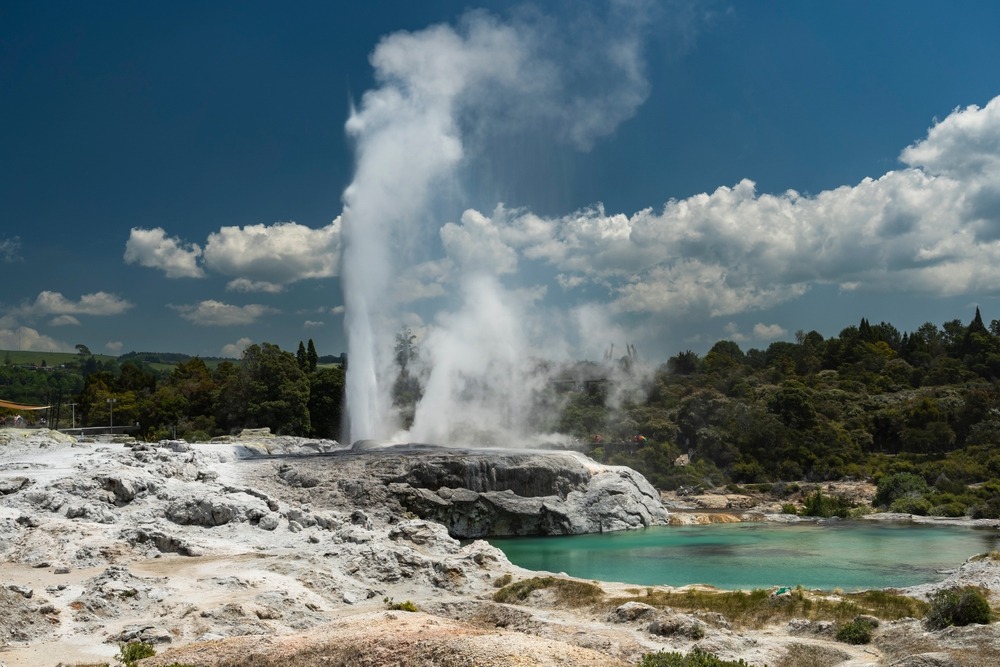
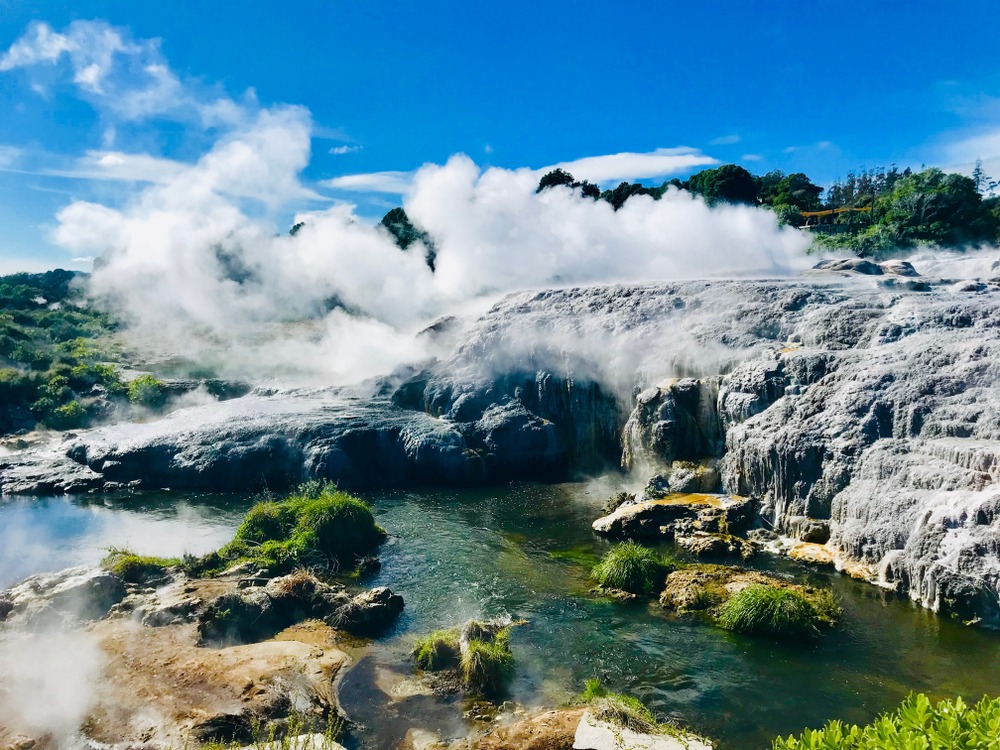
The park also hosts the Band Rotunda (bandstand), the Croquet Pavilion, the Rotorua Bowling Club, the Polynesian Spa on the lakeside, the Rachel Pool and the Te Runanga Tea House. Paths traverse flower beds and border several geothermal pools where steam escapes continuously.
Practical information
Park entry is free and accessible at all times. The facilities within its perimeter (Polynesian Spa, Blue Baths, Rotorua Museum when it reopens) are charged separately, with varying rates depending on services. Allow 1 to 2 hours for a complete walking tour of the park, longer if you combine it with a bathing session. The pathways are flat, accessible with pushchairs and suitable for people with reduced mobility.
A children's playground is located near the Arawa Soldiers Memorial.
When to visit?
Government Gardens can be visited year-round. The Southern Hemisphere spring (September-November) remains the most photogenic period thanks to flowering beds and soft light. Summer (December-February) offers long days, conducive to recreational use of the lawns and Blue Baths' outdoor pools. In winter, steam from the hot springs stands out more vividly in the cold air and gives the park a distinctive character. Avoid peak heat hours in summer if you plan an extended walking visit.
How to get there?
The park is located in the heart of Rotorua, bordered by Queens Drive, Hinemaru Street and Hatupatu Drive. From Auckland, allow approximately 3 hours by road via State Highway 1 then SH5. Long-distance bus connections (InterCity) also link the two cities. Once there, the park is accessible on foot from most central hotels. Parking is available at the immediate surroundings of the site.
What to see in the region
Rotorua is located on the North Island, in the Bay of Plenty region. To extend your visit to other New Zealand sites, consider:
- Cathedral Cove, on the Coromandel Peninsula, accessible within a few hours' drive.
- Canterbury Museum in Christchurch, to deepen your knowledge of New Zealand's cultural history.
- Cape Foulwind and Elephant Rocks, on the South Island, for coastal and geological landscapes.
FAQ
Frequently asked questions
Allow 1 to 2 hours for a complete walk including the main monuments. If you add a session at the Polynesian Spa or Blue Baths, set aside half a day.
No, access to the park itself is free. Only facilities such as the Polynesian Spa, Blue Baths or Rotorua Museum (upon reopening) require an entrance fee.
The historic Bath House building, which houses the museum, is closed for renovation. It remains visible and photographable from the outside. Check the reopening status before your visit.
In the heart of Rotorua, on the shores of Lake Rotorua, in the Bay of Plenty region on the North Island. The park is bounded by Queens Drive, Hinemaru Street and Hatupatu Drive.
Inaugurated in 1927, it pays tribute to Maori warriors who fell during the First World War. Its iconography evokes the arrival of the Arawa canoe at Maketu and represents Rangitihi, ancestor of the local tribes, accompanied by his eight children.
Preparing your trip
Government Gardens naturally integrates into a stay combining Maori culture, geothermal activity and volcanic lakes. To build your tailor-made itinerary, consult our New Zealand travel suggestions.
Nearby
Interested in this visit?
We can include it in your personalised itinerary.