Matamata Hobbiton
Matamata Hobbiton
In Matamata, in the Waikato region, the Hobbiton set reconstructed for the Hobbit trilogy can be visited year-round on an active sheep farm.
In Matamata, on New Zealand's North Island, the Hobbiton filming location attracts visitors from around the world each year. Built for Peter Jackson's Lord of the Rings and Hobbit trilogies, the site is now a permanent attraction situated on an active sheep farm, approximately two hours south of Auckland by road.
Why visit Matamata Hobbiton
Matamata embodies two identities: that of an agricultural village in the Waikato, surrounded by pastures and thoroughbred horse farms, and that of the hobbit village made famous by the films. The Shire set was not demolished after filming; instead, it was permanently reconstructed in 2009 for the Hobbit trilogy, making it one of the rare film locations still visitable in its original form. Tolkien enthusiasts will recognize places they know intimately, yet the site is equally rewarding for non-fans, thanks to the quality of its scenographic design and the beauty of the surrounding hills.
History of Matamata
In Māori, Matamata means "promontory." Before European arrival, the area was already a strategic crossing point. In 1830, chief Te Waharoa established a pā (fortified village) in a marshy valley northwest of Waharoa. Missionaries subsequently settled there: Reverend Alfred Nesbit Brown arrived with his wife in 1833, but departed the following year due to intertribal conflicts.
Te Waharoa's son, Tarapipipi, was baptized in 1839 under the name Wiremu Tamihana. Becoming a respected chief and mediator, he earned the title "The Kingmaker." In 1865, businessman Josiah Clifton Firth, who had come from Auckland, concluded an agreement with Tamihana to lease over 22,000 hectares. He developed an agricultural estate, had a road built to Cambridge, and improved the Waihou River for river transport. The venture ultimately failed, and in 1904, the Crown reclaimed the land to subdivide it into dairy farms.
The arrival of the railway in 1885 accelerated the town's growth. Matamata became an urban area in 1917, gained independence in 1919, and became a borough in 1935, before being incorporated into the Matamata-Piako District during the 1989 reforms.
What to see at the Hobbiton set
In 1998, Peter Jackson was searching for a natural location to bring Tolkien's Shire to life. An aerial survey identified the Alexander family's sheep farm. The New Zealand Army was mobilized to construct the access road and develop the initial hobbit holes, and filming began in December 1999. After the first trilogy, 17 facades remained visible, attracting early visitors. In 2009, the entire set was permanently rebuilt with durable structures for the Hobbit trilogy.
The current set includes:
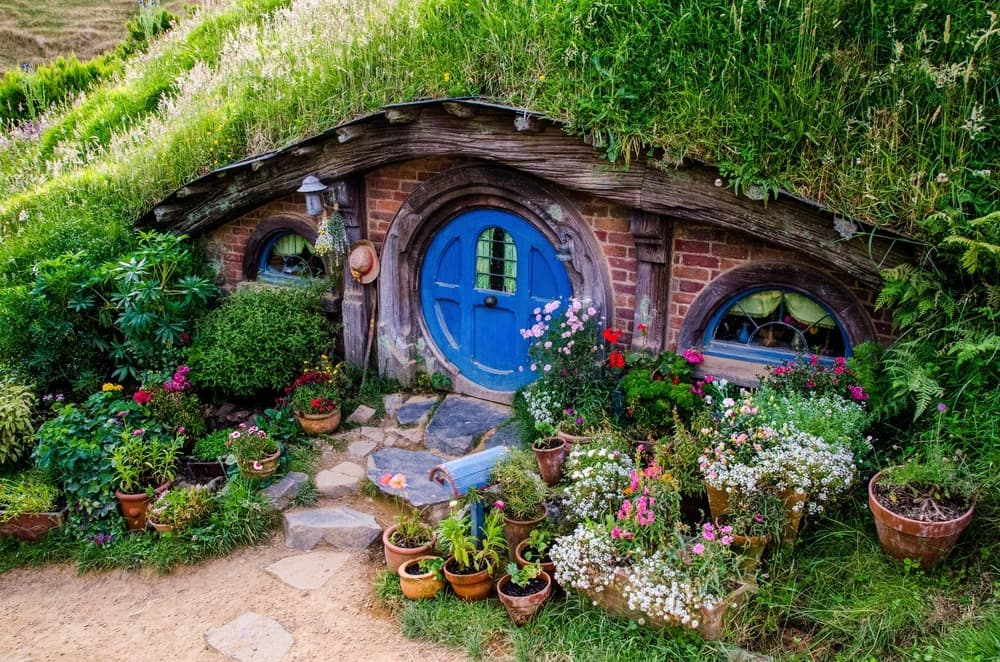
- 44 hobbit holes, including Bag End, the home of Bilbo and Frodo
- The water mill and two-arched stone bridge
- The Party Tree, meticulously recreated
- The Green Dragon inn, where every visitor is served an artisanal beverage (blonde or amber ales, cider, non-alcoholic ginger beer)
Visits are conducted exclusively in guided groups and last approximately two hours for the standard tour. Several extended options exist, featuring meals at the Green Dragon or behind-the-scenes technical exploration. Since the set is integrated into an active farm, independent access is not permitted.
What to do in the town of Matamata
The town itself has embraced its hobbit identity. The Gatehouse, the visitor information center, is decorated in film style, and a Gollum statue stands in the town center. Several shops display names inspired by Tolkien.
The surrounding area offers additional points of interest:
- Wairere Falls (153 m), among the North Island's highest waterfalls, accessible by hiking trail
- The Blue Spring near Putaruru, a source with remarkably clear waters
- The Hauraki Rail Trail cycling path
- Opal Hot Springs, developed thermal pools
- The Firth Tower Museum, housed in Josiah Firth's former tower
- The Matamata Museum, dedicated to local agricultural and film history
For recreation, Matamata boasts two 18-hole golf courses, with seven others nearby. The racecourse hosts race days monthly, and the aerodrome offers gliding flights and skydiving.
Practical information
Booking tickets for Hobbiton is essential, ideally several weeks to months in advance during peak season. The site offers multiple packages: standard guided tour, breakfast or dinner tour at the Green Dragon, and extended "behind-the-scenes" tours with access to artistic workshops. Pricing varies accordingly, from base rates to significantly higher options for meal and backstage packages. Allow two hours for the standard visit and half a day for extended packages. Wear comfortable shoes and bring a windbreaker: the tour is outdoors and Waikato weather can change rapidly.
When to go
The site is open year-round. Peak tourist season corresponds to the Southern Hemisphere summer (December to February) and New Zealand school holidays: availability drops sharply and tickets sell out quickly. Spring (September-November) and autumn (March-May) offer an attractive compromise between soft light, blooming or colorful gardens, and moderate crowds. Winter (June-August) remains feasible, wetter but far less crowded.
How to get there
Matamata is approximately two hours south of Auckland by road, 45 minutes from Hamilton, and one hour from Rotorua. The route from Auckland crosses the Waikato agricultural region. For travelers without a vehicle, regular buses connect Matamata to nearby major cities, and numerous guided excursions combine transport to the Hobbiton set with other regional attractions.
Nearby
Matamata makes a convenient stop between Auckland and Rotorua, integrating easily into a larger itinerary across both islands. To extend your exploration, the Museum of New Zealand Te Papa Tongarewa in Wellington offers a museum perspective on the country, while Arthur's Pass National Park and the Banks Peninsula provide strikingly different landscapes on the South Island. Further south, Moeraki and its spherical boulders are well worth the detour.
Frequently asked questions
Frequently asked questions
The set, known as the Hobbiton Movie Set, is located on a sheep farm near Matamata, in the Waikato region on the North Island, approximately two hours south of Auckland.
The standard guided tour lasts approximately two hours. Packages including meals at the Green Dragon or behind-the-scenes access can extend to half a day.
Yes. Slots are limited and demand is high, particularly during Southern Hemisphere summer. Booking several weeks to months in advance is recommended.
No. Independent access is not available: visits are conducted exclusively in guided groups, as the site is integrated into an active agricultural operation.
Beyond Hobbiton, you can hike to Wairere Falls, swim at Opal Hot Springs, cycle the Hauraki Rail Trail, or visit the Firth Tower Museum and Matamata Museum.
To incorporate Matamata and Hobbiton into a complete itinerary, consult our suggestions for New Zealand trips.
Interested in this visit?
We can include it in your personalised itinerary.