Moeraki
Moeraki
Coastal village on the South Island 76 km from Dunedin, Moeraki is known for its spherical Boulders, marine wildlife and Maori and whaling heritage.
On the east coast of the South Island, approximately 76 km north of Dunedin, Moeraki is a small New Zealand fishing village that has become famous for the stone spheres scattered across its nearby beach. Beyond the Moeraki Boulders, the site combines ancient Maori history, European whaling heritage, remarkable marine wildlife and a culinary scene driven by seafood products.
Why visit Moeraki?
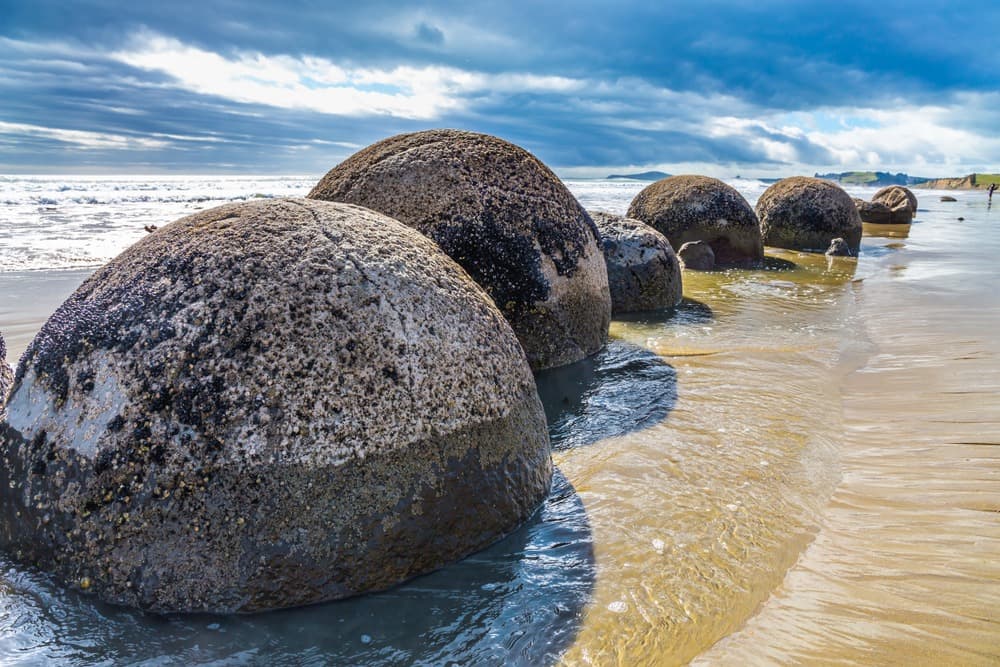
- Marvel at the Moeraki Boulders, more than fifty spherical limestone concretions on Koekohe Beach.
- Spot fur seals, yellow-eyed penguins and, with luck, Hector's dolphins around the peninsula.
- Taste local seafood (blue cod, crayfish) at waterfront restaurants like Fleurs Place.
- Walk the Millennium Walkway, a coastal trail connecting the village to the Boulders site.
- Explore an important historical Maori site, occupied since the 13th century.
History of Moeraki
Occupation of the peninsula dates back to the 13th century and is attributed to the Waitaha tribes, among the oldest in southern New Zealand. In the 18th century, Maori chief Taoka established a fortified village there, testament to a stable indigenous presence well before European arrival.
In 1836, whaler John Hughes established the first European whaling station in the area at Moeraki. The activity declined from the 1840s onward, but settlers remained and turned to fishing and agriculture. In the 1870s, the village was envisioned as the main port of northern Otago: the Moeraki Branch railway line was opened in 1877, but competition from Oamaru and technical difficulties led to its abandonment by 1879. The Katiki Point Lighthouse, erected in 1878, remains one of the visible legacies of that era.
In the 20th century, Moeraki became an established fishing port, equipped for fish processing and sales. Fishing and subsistence agriculture still form the core of the local economy.
What to see in Moeraki
The Moeraki Boulders on Koekohe Beach
A few minutes' drive from the village, more than fifty stone spheres rest on Koekohe Beach. The largest reach 3 metres in diameter and weigh several tonnes. Many display internal cracks called septaria.
From a scientific perspective, these are limestone concretions formed between 65 and 13 million years ago (Paleocene). Minerals slowly agglomerated around organic nuclei on the floors of ancient seas, and ongoing coastal cliff erosion continues to release new ones.
According to Maori legend, the rocks are the remains of the canoe Araiteuru, which came from Hawaiki and ran aground on the coast: baskets, gourds and occupants were allegedly petrified on the beach.
The site is easily accessible via a short trail from the car park. A contribution is generally requested at the entrance to the private path leading down to the beach.
Katiki Point and marine wildlife
The peninsula, around Katiki Point Lighthouse (1878), is one of the best places on the South Island to observe wildlife: fur seals on the rocks, yellow-eyed penguins returning to shore at dusk, little blue penguins, sea lions and several cormorant species. Offshore, you may occasionally spot Hector's dolphins, minke whales or orcas.
The village and its heritage
The village itself is pleasant for a stroll: houses scattered between the hillside and the bay, jetty, harbour viewpoint. The small Kotahitanga church, built in 1862 and adorned with Romanesque stained glass, speaks to a spiritual past still visible today.
Restaurants and seafood
Moeraki's culinary scene was built around Fleurs Place, founded by Fleur Sullivan, who helped put the village on the map for its seafood cuisine. Other establishments round out the offering: The Fishwife, the Moeraki Tavern, and the Moeraki Boulders Café, near the rocks.
Activities
- Millennium Walkway: coastal trail connecting the village to the Boulders, marked with information panels.
- Fishing boat trips for blue cod, crayfish or grouper, often combined with marine wildlife viewing.
- Sea kayaking along the bay to explore the coast in a different way.
- Walks to the Katiki Point historic reserve, on an ancient Maori settlement site where terraces remain.
When to visit Moeraki
The region is accessible year-round, but a few factors guide seasonal choice:
- Tides: the Moeraki Boulders are best viewed at low tide, when the majority of spheres are exposed. Check tide times before planning your visit.
- Southern summer (December-February): long days, more stable weather, ideal conditions for walking, kayaking and boat trips. Peak season.
- Autumn and spring: fewer crowds, soft light appreciated for photographing the Boulders at sunrise or sunset.
- Wildlife: yellow-eyed penguins are observable year-round, especially late in the day; fur seals are continuously present on the rocks.
- Winter (June-August): quiet beaches, wind and cool temperatures, but a contemplative atmosphere.
Practical information
- Visit duration: allow 1 to 2 hours for the Boulders, half a day to a full day to combine village, Katiki Point and lunch.
- Accommodation: independent motels, bed and breakfasts, and the Moeraki Village Holiday Park (cabins, motorhomes, tent sites).
- Access to the Boulders: car park then short trail; contribution requested at the entrance to the private path.
- Protected wildlife: keep your distance from seals and penguins, and respect protection barriers.
How to get to Moeraki
Moeraki is approximately 76 km north of Dunedin and about thirty kilometres south of Oamaru, on State Highway 1. The village is accessed via a 2.5 km sealed road that branches off the main highway, just before the Boulders site.
There is no direct public bus to the village. Long-distance buses between Christchurch and Dunedin can drop passengers at the State Highway 1 intersection, after which you'll need to arrange a transfer or walk to reach the village. A car remains the most practical option.
Nearby attractions
- Elephant Rocks: other spectacular rock formations in the Oamaru hinterland.
- Canterbury Museum in Christchurch, to explore the natural and Maori history of the island.
- Ashburton Lakes, further north, for the lake landscapes of interior Canterbury.
- Franz Josef, on the west coast, to extend your journey towards the glaciers.
Frequently asked questions about Moeraki
Frequently asked questions
These are spherical limestone concretions formed between 65 and 13 million years ago, on the floors of Paleocene seas, by slow accumulation of minerals around organic nuclei. Coastal cliff erosion gradually releases them onto Koekohe Beach.
At low tide, when the majority of spheres are exposed. Sunrise and sunset also offer the most interesting light for photography.
More than fifty are recorded on the beach. The largest reach approximately 3 metres in diameter and weigh several tonnes.
Yes. The peninsula is home to yellow-eyed penguins, a rare and endemic species, as well as little blue penguins. They are best observed late in the day, when they return to shore. Keep your distance and respect protected areas.
There is no direct public bus. Long-distance buses between Dunedin and Christchurch can drop passengers at the State Highway 1 intersection, after which you'll need to arrange a transfer or walk to the village (approximately 2.5 km).
1 to 2 hours is sufficient for the Boulders. Allow half a day to a full day to combine the rocks, village, Katiki Point and a seafood lunch.
Incorporating Moeraki into a New Zealand trip
Moeraki fits naturally into an itinerary between Christchurch and Dunedin, complementing the Canterbury landscapes and Otago coast. To plan a bespoke trip, explore our New Zealand travel ideas.
Interested in this visit?
We can include it in your personalised itinerary.