Complete Guide to Driving in New Zealand
Driving in New Zealand is an experience that requires preparation.
Driving in New Zealand is an experience that requires preparation. Between left-hand driving, local regulations, and specific road signs, it's essential to know the New Zealand traffic code for a successful road trip! Discover our guide to navigating New Zealand roads, along with practical advice on obtaining a certified English translation of your French license (or an international driving permit) required for driving and vehicle rental.
Can you drive in New Zealand with a French license?
A foreign traveler can drive in New Zealand, provided they possess a valid driving license + its certified English translation OR an international driving permit.
Note that an international driving permit will not be valid locally if you do not present your original driving license.
One or the other is essential to drive on New Zealand soil, but also to rent a vehicle (car, campervan, etc.). The only difference is the duration of validity. Here are the steps to obtain either document…
Requesting a translation of your national driving license
The translation of your French license (Belgian, Swiss, etc.) must be completed by a translator approved and recognized by the New Zealand Ministry of Transport (Waka Kotahi NZ Transport Agency – NZTA). Several approved organizations offer this service: the list of driver licensing agents is available on the official NZTA website.
Translation fees range between €15 and €50, and the average time to obtain the document is three business days (or within 24 hours for expedited requests, with an additional fee for express processing).
The validity of the translation expires on the same date as your national driving license. However, you can only drive for 12 months in New Zealand with a French license and its translation. Beyond one year, you must apply for an international permit.
Please note According to the official French government website, "the validity of the driving license should not be confused with the validity of your driving categories. So even if your license is valid for only 5 or 15 years, your category B permit allowing you to drive a car remains valid for life (except for individual restrictions, for example for health reasons)". ● The driving license document format refers to your license type. It can be in 'credit card' format or a three-panel 'cardboard pink' folding format. ● The expiration date of the 'credit card' format driving license is indicated on the front, at line 4b. ● The validity of the pink license remains valid until January 19, 2033. |

Requesting an international driving permit
If you plan to stay in New Zealand for more than 12 months, you will need an international driving permit. Valid for 3 years, it does not require translation. The application process takes place in France in two steps.
Apply online on the website of the National Agency for Secure Documents (ANTS) to complete a form.
Send your file by mail once your digital application has been submitted online.
The documents to provide are:
A proof of identity (national ID card, passport),
A proof of residence dated less than 6 months old,
A valid national driving license in good condition,
An identity photo dated less than 6 months old (in digital or paper format).
Depending on the season, processing your file can take some time. To ensure you have the permit in time, it is recommended to apply at least six months before your departure. The international driving permit is issued free of charge.
Caution: in case of a police check, you face a €350 fine if you do not possess one of the two permits (national license + translation OR international permit).
Where and how to rent a vehicle in New Zealand?
Minimum age
Regardless of which permit you choose, one or the other is essential to rent a vehicle. The minimum age to rent a vehicle in New Zealand is generally 21 years old, with a full license held for at least 1 year.
Insurance
Young driver insurance
Some agencies allow driving from age 18 provided you subscribe to specific insurance (approximately €10 extra per rental day).
Auto insurance
In theory, purchasing auto insurance when renting a vehicle in New Zealand is not mandatory. However, note that most rental agencies include this protection in the rental price – and it is highly recommended in case of accident or theft.
Note that supplementary insurance excludes any fines related to speeding violations or improper parking. The insurance price varies depending on the options chosen.
|
Rental agencies
There are numerous rental agencies in New Zealand, including Europcar, Hertz, and AVIS. Most chains have offices at airports and major cities, such as Auckland, Wellington, or Christchurch. They also operate near bus or railway stations and tourist ports, like Picton. Most allow vehicle return in a different city than the departure location.
Is it easy to drive in New Zealand (and what are the rules)?
Before taking the wheel in New Zealand, it's important to know the traffic code and main circulation rules. An adaptation period is necessary the first few days, but reflexes develop quickly. Here's a small guide to the essentials for stress-free driving in the land of kiwis.
Tailored itinerary for a New Zealand road trip... Are you panicking about getting the paperwork right or planning all the stages of your road trip? Designed by our local agency, this itinerary allows you to explore the country's most beautiful spots by road trip, with complete peace of mind. If you have any doubts or questions, don't hesitate to contact the Antipodes Travel team: our English-speaking team is here to help you. |
New Zealand traffic code
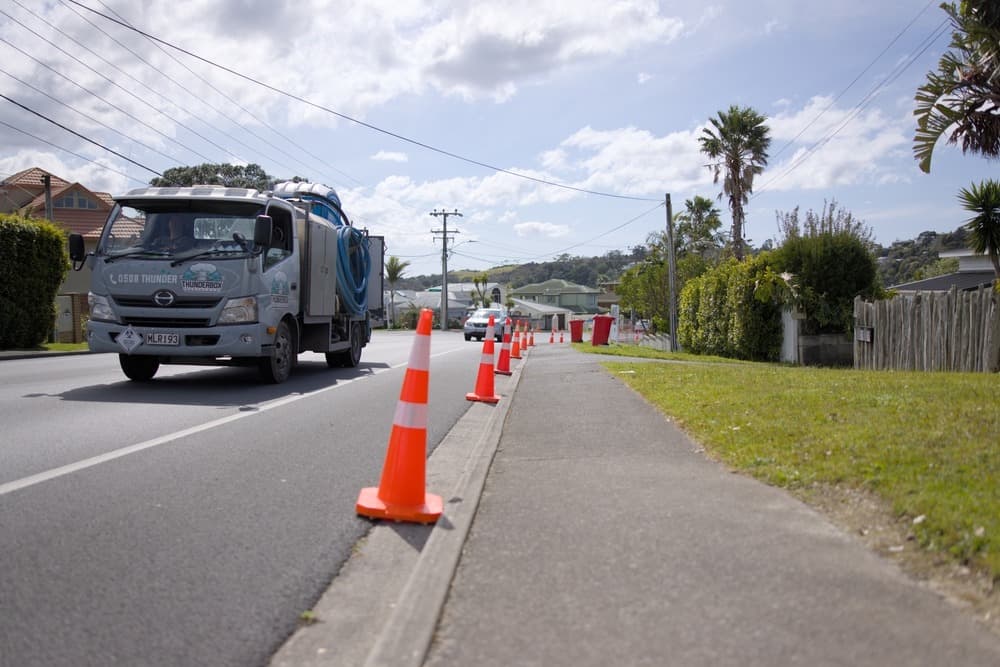
Driving takes place on the left side, and therefore, no matter what, remember that your vehicle must always be positioned to the left of the road. For example, after turning right at an intersection, the vehicle must be on the left lane after the turn. Also note that the windshield wiper and turn signal levers are reversed (except on some European models).
Road signs also require particular attention, as many don't exist in France. To prepare as best you can, feel free to consult the signs on the official NZTA-Waka Kotahi website.
As a general rule, remember that triangle-shaped signs on a yellow background indicate danger. This could be a curve or pedestrian crossing, but also a warning about animals in the area. For example, it's not uncommon to see signs warning of penguins, kiwis, or pukekos (endemic wild birds). Amusing warnings, but to be taken seriously.
Speed limits are somewhat different from ours.
Highways and main roads are limited to 100 km/h (90 km/h for campervans over 3.5 tons),
In built-up areas, speed ranges between 30 and 50 km/h (depending on zones in certain cities).
New Zealand drivers may find your driving a bit slow. In that case, don't panic. Simply pull over to the side when possible to let them pass. Conversely, avoid accelerating abruptly as soon as a straight road appears: local drivers often wait for such stretches to safely overtake!
Note that non-compliance with speed limits is severely sanctioned – as is the use of a smartphone while driving.
Overtaking also requires some attention. Indeed, most roads have only one lane per direction. To overtake, it's best to use dedicated zones named passing lanes. Note that the no-overtaking restriction is marked by a yellow line (equivalent to our white line in France) and overtaking is always done on the right.
Traffic in roundabouts moves clockwise and overtaking is also done on the right. Don't worry, each entry is equipped with a yield sign, which makes merging easier. Just watch your right and proceed when the way is clear.
Parking is also regulated. To park on a street, whether one-way or two-way, your vehicle must be parked in the same direction as your direction of travel, at the risk of receiving a fine or being towed.
If you drive a campervan, be aware that there are many dedicated parking areas (and free ones), as well as inexpensive spots in campgrounds. Budget between NZ$40 and NZ$80 (€20 to €40) for a spot with electricity.
Single-lane bridges (one lane bridges) are fairly common in New Zealand, especially on the South Island. These can be announced by a Stop sign, a Yield sign, or traffic light. In any case, it is strictly forbidden to stop on the bridge to admire the scenery or take photos.
Railway crossings also require great attention. Why? In New Zealand, many of them are not equipped with automatic barriers and are simply marked by the Railway Crossing sign!
When there is a barrier, the signage is often supplemented by a Stop or Give Way sign. In either case, exercise extra caution when approaching a railroad crossing.

Drinking and driving
Alcohol consumption is limited to 50 mg per 100 ml of blood for those over 20 years old and is completely prohibited for drivers under 20. In case of violation (driving under the influence of alcohol or drugs), you face severe penalties.
Traffic violations and fines
In 2025, road offense amounts are:
Speeding: €15 to €315 (depending on the excess),
Using a mobile phone while driving: €75
Failure to wear a seatbelt (mandatory for all passengers): €75
Non-compliance with road signs: €75
Excessive blood alcohol level: the fine can reach €2,260 for a level of 80 mg per 100 ml.
Note that fines can be paid online on the official New Zealand Police website.
Child car seats
If you travel with a child under 8 years old, they must be secured in an approved car seat (car-seat) or until the child reaches 1.48 meters in height. This mandatory equipment incurs an additional cost when renting a vehicle (check with the agency for details).
Winter driving
In winter, it's not uncommon to see snow and ice on the roads. To avoid trouble, equip your vehicle with the required accessories! Also, always plan to have enough fuel; road closures may require long detours.
What types of roads are in New Zealand and are they well maintained?
National roads (State highways)
Contrary to what their name might suggest: State highways are not motorways. These are two-lane national roads with no central divider, with a speed limit set at 100 km/h.
These roads require great vigilance, especially in winding areas (such as around Queenstown or Rotorua) where visibility in curves can be very limited.
It's also recommended to keep your headlights on even during the day to signal your presence. Unlike some European countries, New Zealanders don't honk to announce their passage on mountain roads.
Secondary roads
There are two types of secondary roads.
Sealed roads: paved roads that allow two vehicles to pass without much difficulty. These are fairly easy to travel on, respecting speed limits.
Gravel roads: gravel roads, very common in the backcountry (or to reach hiking starting points). These tracks can be more irregular, with poor visibility, and yet the maximum authorized speed is often the same as on national roads! Adjust your speed and drive at a maximum of 50 km/h!
Motorways (Motorways)
There are only three toll motorways in New Zealand. These are all located on the North Island (and are inexpensive). These three roads are also the only ones where you'll find rush hour traffic jams (around 8 a.m. and 6 p.m.).
Northern Gateway near Auckland: a 7.5 km motorway located north of Auckland, between Silverdale and Pūhoi. Rate: €1.30
Tauranga Eastern Link: a 15 km expressway connecting the Domain Road interchange (near Pāpāmoa) to the Paengaroa roundabout (towards Whakatāne and Rotorua). Rate: €1.15
Takitimu Drive around Tauranga: a 5 km motorway that bypasses Tauranga city center toward the Port of Tauranga and Mount Maunganui. Rate: €1.05.
The amount is higher for certain heavy vehicles, such as large campervans (around €2.80).
Limited to only 100 km/h (110 km/h for Tauranga Eastern Link), these three motorways are prone to speeding… Our advice? Use a GPS with an audio alert to avoid unintentional speeding and fines.
Some free motorway sections allow a maximum speed of 110 km/h.
New Zealand motorways: a closer look at tollsUnlike French motorways, New Zealand tolls have no barriers with direct cash or card payment, and instead function by scanning the license plate via cameras. ● Once you've used the section, payment is made afterward online on the official website or at a physical point (such as certain gas stations). Tolls must be paid within five business days following your passage, otherwise additional fees apply. To pay, you can use a bank card or the POLi service (if you have a New Zealand bank account). ● Some rental agencies offer prepaid packages or temporary passes. In this case, the toll is then charged directly to the agency. |
Roads to avoid (or prohibited)
Note that some roads cannot be used by rental vehicles due to insurance reasons. This is the case, for example, with the famous Ninety Miles Beach (also named Te-Oneroa-a-Tōhē).
This "road" is actually a long beach that allows you to reach Cape Reinga, at the northernmost point of the country. However, this route is most often not authorized by rental agencies – each rental company informs its customers of prohibited or dangerous routes when handing over the vehicle keys.

What type of vehicle should you rent to drive in New Zealand?
To travel New Zealand's roads (often winding and with elevation changes), it's recommended to choose a vehicle combining comfort, good road handling, and moderate fuel consumption.
The car
Ideally, a recent compact hybrid SUV that's easy to drive and maneuver in urban and rural areas.
For example, a Toyota Corolla Crossover model (or equivalent) allows you to drive on both countryside and paved roads – and cover long distances without consuming too much fuel (preferably 91 octane unleaded).
The van or campervan
If you rent a van or campervan in New Zealand, you will need, as with a car, your French category B license and its English translation (or an international permit). In France, the category B permit allows you to drive cars, vans, and small campervans with a maximum weight not exceeding 3,500 kg.
Caution: as of 2024, New Zealand has tightened its wild camping rules (due to a sharp increase in tourist campervans and misconduct, such as littering in nature...).
Now, to practice free-camping in unmanaged areas: a campervan must comply with the NZS 5465 standard and obtain the green "Self Contained" sticker. This guarantees that the vehicle has its own supply of drinking water (for several days) and a sealed waste container.
This green-sticker has a cost, which is reflected in the rental price of an autonomous, equipped campervan. Budget approximately €75 additional per rental day.
A closer look at fuel prices in New Zealand1/ Fuel prices in New Zealand are generally cheaper than in France, and rates are nearly identical across all regions. In August 2025, average fuel prices hover around: ● 98: €1.45/liter ● 95/96: €1.45/liter ● 91: €1.30/liter ● Diesel: €0.91/liter Note that most rental cars run on premium unleaded, 95/96 or 98, while 4x4s or campervans run on diesel. 2/ While most gas stations are open 24/7, note that those in remote or rural areas may be closed all weekend. |
Frequently asked questions
Is it difficult to drive on the left?
Driving on the left requires a short adaptation period, particularly regarding habits at intersections and roundabouts, which require looking to the right—and not to the left. To help yourself, keep in mind that you drive in a clockwise direction (and stay in the left lane in curves). If you're traveling with someone, the passenger can also be a co-pilot who can guide you and help you stay extra vigilant.
Is it dangerous to drive in New Zealand?
Driving in New Zealand is not particularly dangerous. The main danger is fatigue. To handle long distances and stay alert on winding roads, it's recommended to take regular breaks – ideally, a 15-minute break every two hours.
Are New Zealand roads well maintained?
New Zealand's main roads are generally well maintained. NZTA (NZ Transport Agency Waka Kotahi), responsible for most roads, implements an extensive resurfacing program each summer covering up to 10% of the road network. Some secondary roads may, however, have potholes.
Do you need special insurance for a New Zealand road trip?
There is no specific insurance for a road trip. When renting a vehicle in New Zealand, basic insurance is typically included in the package. However, this coverage often carries a high deductible. To reduce this deductible, it's recommended to purchase Collision Damage Waiver (CDW) coverage. Although CDW is not mandatory, it is often required or included in the package and allows lower costs in case of damage.
Note: amounts in euros were calculated based on New Zealand dollar amounts.
Frequently asked questions
Yes, a French driving license is accepted in New Zealand, provided you present it with an official English translation (completed by an NZTA-approved translator). This combination is valid for a maximum of 12 months. Beyond that, an international permit is mandatory. In both cases, the original document must always be presented in case of inspection.
The international permit is requested via the ANTS website (National Agency for Secure Documents) in France. Processing can take several weeks depending on the season. It is strongly recommended to submit your application at least 6 months before departure. Issuance is free, and the permit is valid for 3 years.
Auto insurance is not legally mandatory when renting a vehicle in New Zealand, but it is strongly recommended. Most agencies include it in the rental price. Note that standard insurance does not cover fines for speeding or improper parking. Drivers under 21 may need to purchase young driver insurance (approximately €10/day).
In 2025, speeding fines in New Zealand range from €15 to €315 depending on how much over the limit you were. Using a mobile phone while driving, failure to wear a seatbelt, and non-compliance with signs are each punishable by €75. Fines are paid online on the official New Zealand Police website.
Yes, New Zealand is very well equipped for campervans, with many free parking areas and inexpensive campgrounds (between €20 and €40 for a spot with electricity). As of 2024, to practice wild camping (free-camping) in unmanaged areas, the vehicle must be certified 'Self Contained' (NZS 5465 standard), which incurs an additional cost of approximately €75/day at rental.
New Zealand tolls have no physical barriers. Cameras automatically scan your license plate. You then pay online or at a physical location within 5 business days of your passage, or incur additional fees. You can pay by bank card or POLi service (if you have a New Zealand bank account). Some rental agencies offer prepaid toll passes to simplify the process during your road trip.