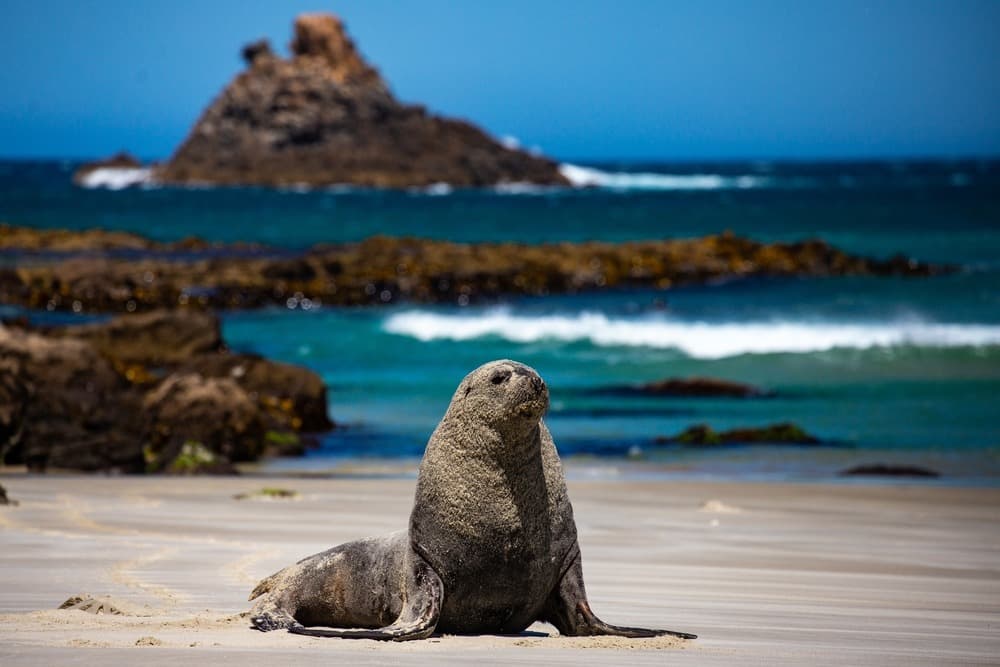
Wildlife of New Zealand
Planning a trip to New Zealand and eager to discover the local fauna?
Planning a trip to New Zealand and eager to discover the local fauna? A land of birds and kingdom of cetaceans, the home of the Kiwis promises wonderful encounters for all animal lovers. But what are the emblematic animals to see during a trip to New Zealand? Follow the guide...
In summary:
Animal Categories | Emblematic Species |
Land Mammals | Possum (ringtail possum), wild pigs, deer, rats, weasels, stoats... All introduced and considered invasive. |
Land Birds | Kiwi, Kākāpō, Takahē, Wéka, Kéa, Tūī, Pūkeko, Kererū... |
Seabirds | Yellow-eyed penguin, Little penguin, Fiordland crested penguin, Snares crested penguin, Albatross... |
Cetaceans | Sperm whale, Bryde's whale, Humpback whale, Southern right whale, Killer whale, Hector's dolphin, Dusky dolphin, Common dolphin... |
Pinnipeds | New Zealand fur seal, Sea lion, Southern elephant seal, Leopard seal... |
Sharks | Basking shark, Shortfin mako, Lemon shark, Great white shark... |
Land Mammals to See in New Zealand
Rare and Non-Endemic Mammals
Surprisingly, land animals don't feature prominently in New Zealand's wildlife kingdom.
Indeed, aside from two species of bat (the long-tailed bat and the lesser short-tailed bat), no terrestrial mammal is endemic to the country. Most of the mammals encountered on land were imported to the archipelago throughout history. This is the case with wild boars and feral pigs, deer, rats, weasels, stoats and other carnivores that all arrived with Māori and European settlers.
Among the animals imported to New Zealand, one became as emblematic as it is controversial:
The Possum (Ringtail Possum)

With its adorable face, it's hard to believe it's one of the country's main enemies. The possum (or ringtail possum) is a species of small arboreal marsupials native to Australia. Equipped with magnificent fur and a bushy prehensile tail, it was introduced to New Zealand in the nineteenth century to develop the fur trade.
The problem? The possum (not to be confused with the opossum found in North and South America) rapidly proliferated, and having no natural predators except humans, it became a pest to be eliminated. Why? Because:
it feeds on leaves and fruit, preventing the growth of indigenous trees,
it transmits bovine tuberculosis,
it devours numerous eggs and chicks from endemic species such as the kea, kākāpō and kiwi,
it constitutes a formidable competitor for food and habitat of local species.
As you can see, the possum has become a species to be eliminated because it greatly disrupts different ecosystems. In response, authorities hunt it down and invest in intensive control programs: trapping, poisoned baits, culling... The long-term goal is even to eradicate it completely by 2050 (the "Predator Free 2050" programme).
Where to See Possums in New Zealand? The possum is a nocturnal animal encountered throughout the country. It is widely distributed in the indigenous forests of Northland, Waikato, West Coast and in national parks such as Fiordland, Abel Tasman, and Kahurangi. Note: you'll see many flattened on roads. |
Emblematic Birds to See in New Zealand
Long before humans set foot in New Zealand, birds reigned supreme throughout the country. Although many species are threatened today, birds perfectly represent the richness of local fauna.
The Kiwi, the National Icon

Endemic to New Zealand, the kiwi is considered the national icon, to such an extent that locals prefer to call themselves "kiwis" rather than "New Zealanders". About the size of a hen, the kiwi is characterised by small eyes and a long beak with nostrils at the tip. Its wings, reduced to stumps, prevent it from flying, making it an easy prey for introduced predators. Nevertheless, it moves by trotting and can be very fast when threatened.
Unfortunately, it's an endangered species that is difficult to observe. In addition to becoming increasingly rare, the kiwi is a shy animal that lives mainly at night. To attempt to spot it in its natural habitat, it is recommended to take a guided tour with a local guide.
Where to See Kiwis in New Zealand? As mentioned, it's difficult to see kiwis in the wild in New Zealand. That said, you may be able to observe them in certain sanctuaries or nature reserves such as:
|
The Wéka

The wéka (or Weka rail) is a land bird endemic to New Zealand. It is frequently confused with the kiwi due to their similar appearance. The size of a chicken, it has a squat body with beige-brown plumage streaked with black and a distinctive long beak. Like the kiwi, it cannot fly, but is an excellent swimmer and, unlike the latter, is a daytime bird and very curious.
Unlike the kiwi, the wéka is easily observable. It's a bold bird that doesn't hesitate to approach campers and walkers. It even sometimes follows them, hoping to snatch a piece of their sandwich.
Where to See Wéka in New Zealand? Unlike the kiwi, the wéka can be easily observed in the wild during the day. You can see it:
|
The Kākāpō
Also called the owl parrot, the kākāpō is a nocturnal species of parrot endemic to New Zealand. Reaching a size of 60 cm and a weight of 4 kg, it's the heaviest parrot in the world. It also has the distinction of being the world's only non-flying parrot and one of the birds with the longest life expectancy (around 90 years). Apart from its large size, the kākāpō is easily recognised by its yellow-green marbled plumage.
Sadly, it's almost impossible to see a kākāpō in the wild. Indeed, it's a critically endangered species. It nearly disappeared due to the introduction of predators such as cats and rats.
Where to See Kākāpō in New Zealand? Strictly protected, the kākāpō lives only on predator-free sanctuary islands, accessible only to scientists and wildlife protection professionals. |
The Kéa (or New Zealand Alpine Parrot)

Here's another parrot species with unusual attributes. Indeed, the kéa is the world's only alpine parrot. Endemic to the South Island of New Zealand (found nowhere else), this olive-green parrot with red on the underside of its wings owes its name to its powerful cry: "keee-aa".
Capable of solving puzzles and using tools, it is considered one of the most intelligent birds in the world. It is also known for its playful and thieving temperament: it's often seen ripping rubber seals from cars and opening backpacks to steal shiny objects.
Where to See Kéa in New Zealand? The Kéa is present, in the wild, only on the South Island of New Zealand. You can observe it around the Arthur's Pass National Park, Franz Josef and Fiordland National Park and in the vicinity of the Mount Cook village in Aoraki/Mount Cook National Park. |
The Tūī

Also known as the Tui honeyeater and Tui curly-frilled, the Tūī is a species of passerine endemic to New Zealand. Measuring about 30 cm long, it has iridescent blue-green plumage with brown-black spots on the wings and two tufts of white feathers beneath the neck.
It's one of New Zealand's emblematic birds because of its song. Indeed, it's capable of imitating many sounds: as well as the songs of other birds, telephone ringtones or even the human voice! If you hear a robotic or grating cry similar to that of the famous Star Wars robot R2D2, there's a good chance it's him!
Where to See Tūī in New Zealand? The Tūī is a common bird, found in the wild in both main islands of the country. It can be found in forests as well as in parks and urban gardens. You can be sure to see some at:
|
The Pūkeko

Pūkeko is the New Zealand name for the purple swamphen. It's a common bird and one of the few indigenous birds that has managed to adapt to environmental changes. Nicknamed the "blue pheasants" or "marsh hens", they live in the marshes and wetlands of the country. They're found as much in pastures and farmland as in wetlands or along marshy roadsides.
They're easily recognizable by their brilliant blue-violet plumage on the breast and belly and black on the back, as well as their bright red beak. It holds an important place in Māori culture, where it carries many symbolic meanings.
Where to See Pūkeko in New Zealand? The Pūkeko is a common bird, easy to observe everywhere in the country, particularly in open wetland areas. You can observe it in:
|
The Kererū (Wood Pigeon)
The kererū (Māori name for the New Zealand pigeon or wood pigeon in English) is a species of pigeon endemic to New Zealand. It's the country's only pigeon species and one of the world's largest pigeons. It's characterised by iridescent blue-green plumage, a brilliant white breast and a red beak.
Unlike our urban pigeons, the kererū is a forest bird in New Zealand. It's easily spotted by its colours, but also by the distinctive sound of its wing beats.
Where to See Kererū in New Zealand? The kererū is widespread throughout New Zealand, but more common in forested and protected areas. |
The Royal Albatross

With a wingspan that can reach up to 3.20m, the royal albatross is one of the world's largest seabirds. It's marked by white plumage with black wings that tend to lighten with age until they become completely white except for the tips. It has a pale pink beak, long and thick with a hooked tip.
It's a fascinating bird to watch, especially in flight. They're excellent gliders, capable of covering thousands of kilometres without flapping their wings. They're known for being very faithful since they're monogamous: they form a couple for life after years of courtship displays and always return to the same place for nesting.
Where to See Royal Albatrosses in New Zealand? The best place to see royal albatrosses in New Zealand is Taiaroa Head, a promontory at the tip of the Otago Peninsula that is home to the only Northern Royal Albatross colony, along with the Chatham Islands. As for Southern Royal Albatrosses, they are found on the subantarctic islands of Campbell and Auckland, but access is limited to scientists or specialised cruises. |
Penguins
Several species of penguins can be observed in New Zealand, here are the main ones:
The Yellow-Eyed Penguin (or Antipodean Penguin)

This highly threatened endemic species is one of the rare solitary penguins and one of the rarest penguins in the world. It's recognised by its dark black-grey plumage on the back, white belly and pale yellow head with characteristic yellow eyes. It's a very discreet penguin that nests in forests and prefers to be reclusive rather than in large colonies. It's most easily observed in the late afternoon during the nesting period (between October and March).
Where to See Yellow-Eyed Penguins in New Zealand? The yellow-eyed penguin can be seen at:
|
The Little Penguin (or Little Blue Penguin)

Characterised by different shades of indigo blue on the back, head and wings and a white belly, the little penguin (also called the little blue penguin) is the smallest penguin species in the world. This nocturnal species lives in burrows, leaves land for sea before sunset and only returns when it's dark to avoid predators.
Where to See Little Penguins in New Zealand? The little blue penguin is observed at:
|
The Fiordland Crested Penguin
The Fiordland crested penguin is a rare species endemic to south-west of the South Island of New Zealand. Of medium size, it has black and white plumage. Belonging to the genus Eudyptes, it's distinguished by a pale yellow crested arch above the eyes. Very discreet, it nests in damp forests or rocky caves near waterfalls.
Where to See Fiordland Crested Penguins in New Zealand? The Fiordland crested penguin can be spotted at:
|
The Snares Crested Penguin

Like the previous species, the Snares crested penguin is easily recognised by its characteristic yellow crest. Its head, cheeks, throat and back are black while its belly is white. A patch of pink skin (without feathers) at the base of the beak distinguishes them from Fiordland crested penguins. It's an endemic species of the Snares archipelago (south of the South Island): found nowhere else.
Where to See Snares Crested Penguins in New Zealand? This species is only found in the dense forests of the Snares Islands. Access is highly regulated and observation is only possible through authorised expedition cruises from Invercargill or Bluff. |
The Erect-Crested Penguin
The erect-crested penguin also belongs to the genus Eudyptes. But unlike other species, it's the only one whose crest is completely upright and doesn't fall over the eyes (hence its name). It has a black head, upper throat and cheeks and a back ranging from bluish-black to black. It's found on the subantarctic islands linked to New Zealand (Campbell Island, Antipodes Island, Auckland Island).
Where to See Erect-Crested Penguins in New Zealand? The erect-crested penguin is found only on Campbell, Antipodes, Bounty and Auckland Islands. These nature reserves are only accessible by authorised scientific cruises. |
Essential Marine Animals to See in New Zealand
Lovers of marine creatures will be delighted during a trip to New Zealand. Indeed, the country is located in the world's fourth-largest marine territory. Known as a world leader in the protection of marine mammals, it is estimated that nearly half of the world's whale species live in New Zealand waters.
Cetaceans (Whales, Dolphins...)
The Sperm Whale

Reaching up to 18 m in length, the sperm whale is characterised by a massive head that represents nearly a third of the animal's body. Its dark grey or black body with some spots on the belly has no dorsal fin, but a series of ridges on the rear third of the back. It's known for having the largest brain in the animal kingdom and for being capable of diving to depths of 3000 m.
The sperm whale is a resident species in New Zealand: it can be seen year-round, though sightings are more frequent between September and April.
Where to See Sperm Whales in New Zealand? Kaikōura, on the South Island, is the best place to see sperm whales in New Zealand. They can be observed during a boat trip, from the shore (with binoculars) or during a plane flight. |
The Bryde's Whale

Measuring up to 15 m in length, Bryde's whale is distinguished from other species by the presence of three longitudinal ridges on the top of the rostrum. It's blue-grey in colour on the back and yellowish-white on the belly.
Bryde's whale is one of the few whale species present year-round in New Zealand, particularly in the subtropical waters of the North Island. Rapid and relatively discreet, it's frequently encountered, but sightings are more numerous between November and April.
Where to See Bryde's Whales in New Zealand? The Hauraki Gulf is considered the best place to see Bryde's whales in New Zealand waters. Sea trips are made notably from Auckland port. |
The Humpback Whale

The humpback whale is one of the most spectacular cetacean species to observe in New Zealand. Offering an extraordinary spectacle to animal lovers (complex melodious songs, spectacular jumps, flipper slaps, tail flukes...), it's one of the most sought-after cetaceans for whale watching. It has long pectoral fins with bumps, a dark or dark grey body with a white belly and a large fan-shaped tail.
New Zealand waters are part of the humpback whale's migration route. These whales migrate northward between June and August and migrate towards Antarctica between September and November.
Where to See Humpback Whales in New Zealand? The best places to see humpback whales are:
|
The Southern Right Whale
The Southern right whale is a rare and emblematic species of the southern hemisphere. It was long hunted, but is making a gradual comeback in New Zealand waters. Reaching 18 m in length, it's recognised by its very large head with horn-like callosities (white or greyish rough patches on the head).
Unlike sperm whales or humpback whales, right whales are often visible from shore without a boat trip. They're very calm and generally stay near the surface.
You can see them during the austral winter (between June and September), when females come to give birth near the coast and stay for several weeks to raise their calves.
Where to See Southern Right Whales in New Zealand? Southern right whales are mainly observed on the South Island, at Foveaux Strait, Otago Peninsula and Southland & The Catlins and sometimes at Stewart Island and Rakiura. |
The Orca (Killer Whale)

Orcas (or killer whales) are among the most impressive marine predators. They're at the top of the food chain: they're capable of attacking dolphins, seals and even whales! Measuring up to 9 m in length, they're the largest members of the Delphinidae family, the same family as dolphins.
In New Zealand, they're present year-round, but their observation remains unpredictable because they cover vast distances.
Where to See Orcas in New Zealand? Orcas can be observed:
|
Hector's Dolphin (Hector's Dolphin)

Hector's dolphin is an endemic species of New Zealand. It's the smallest dolphin in the world (measuring between 1.2 and 1.5 m in length). Recognizable by its stocky silhouette in light grey with a white belly, it has a rounded "Mickey Mouse ear"-shaped dorsal fin. It's one of the most threatened cetacean species worldwide.
This coastal species is observable year-round. It evolves often in less than 100 m depth and shows very active and curious behaviour. It's frequently seen, in small groups of 2 to 8 individuals, performing acrobatics beside boats.
Where to See Hector's Dolphins in New Zealand? Hector's dolphin lives exclusively in the coastal waters of the South Island, especially on the east coast. Akaroa Harbour (near Christchurch) is considered the best place to see it during a boat trip. You can also see it from the shore of the Banks Peninsula, in Southland (Porpoise Bay, Curio Bay) or at Te Waewae Bay. |
The Dusky Dolphin (Dusky Dolphin)

The dusky dolphin, also called the dusky dolphin, is one of the most acrobatic and sociable dolphins in the world. It has a dark to black back, light grey to white flanks and a white belly, often with curved lateral bands. Its colouring gives the impression that its skin is marbled.
In New Zealand, it's a very widespread species year-round, especially in the cold waters of the South Island, where it's relatively easy to observe. Very playful, it's seen performing leaps and rolls and sometimes even surfing on waves and boat wakes. It lives in very large groups of up to a hundred individuals.
Where to See Dusky Dolphins in New Zealand? The dusky dolphin is one of the most visible dolphins in the country, especially in the South Pacific. They're frequently observed at Kaikōura, as well as in Marlborough Sounds, Akaroa & Banks Peninsula and at Stewart Island and Rakiura. |
Note that bottlenose dolphins and short-beaked common dolphins are also regularly found in New Zealand waters.
Pinnipeds (Seals, Sea Lions...)
In addition to its cetaceans, New Zealand waters are known to harbour numerous species of pinnipeds, that is, semi-aquatic marine mammals with flipper-like paws.
The New Zealand Fur Seal

The New Zealand fur seal, also called kekeno in Māori, is one of the country's most emblematic marine mammals. This species is characterised by brown to dark grey fur, with a dense and waterproof undercoat, a head with a pointed snout and white whiskers, and long and powerful flippers.
Once hunted almost to extinction, this species has made a remarkable comeback and is now widely observable on the rocky coasts of the South Island and some parts of the North Island. Very agile, the New Zealand fur seal is capable of climbing steep rocks.
Where to See New Zealand Fur Seals? The fur seal can be observed at:
|
The Southern Elephant Seal

The Southern elephant seal (or Southern elephant seal) is the world's largest pinniped (up to 6 m long and weighing 4 tonnes in males) and a spectacular, though infrequent, visitor to New Zealand's coasts. It takes its name because of the elongated trunk-like snout that males possess.
This species, usually associated with subantarctic islands, has no permanent colonies on New Zealand's main islands, but solitary individuals are sometimes observed, particularly on southern beaches.
Where to See Southern Elephant Seals in New Zealand? Southern elephant seals aren't common on the country's main islands, but they can be observed in certain locations and circumstances. True breeding colonies are found on the New Zealand subantarctic islands, particularly on the Auckland Islands, on Campbell Island or on the Antipodes and Bounty Islands. All these islands are protected areas: the number of visitors is limited and access is restricted and supervised. |
The Leopard Seal

This impressive pinniped is recognizable by its reptilian head, powerful jaw and spotted fur, to which it owes its name. The leopard seal is known to be extremely powerful and ferocious. Unlike other species, the female is much more imposing than males and can reach up to 3.80 m and weigh up to 500 kg.
It's one of the most fearsome marine predators of the Antarctic. It's present in New Zealand seasonally (during the austral winter, from June to September), mainly on the south coast of the South Island and on subantarctic islands.
Where to See Leopard Seals in New Zealand? The leopard seal can be seen at:
|
And Sharks?
Are there sharks in New Zealand? If you're asking yourself this question, know that the country's waters are home to many shark species, including:
The basking shark,
The great white shark,
The shortfin mako,
The smooth dogfish (or porbeagle or mackerel shark),
The lemon shark,
The reef sharks (blacktip or whitetip...)
Important to Note! Unlike Australia, shark attacks are very rare in New Zealand. To give you an idea, fewer than 50 attacks have been recorded in 180 years! |
Need help organising your trip to New Zealand and meeting the country's emblematic animals? Let's talk about it!
In the meantime, find inspiration with our three circuits focused on New Zealand's wildlife and flora:
Frequently asked questions
The kiwi is the emblematic animal of New Zealand, so much so that the inhabitants call themselves 'Kiwis' rather than 'New Zealanders'. It's a nocturnal land bird, endemic to the country, flightless and currently threatened with extinction.
Seeing kiwis in the wild is difficult because they're nocturnal and increasingly rare. The best chances are found in sanctuaries like Zealandia in Wellington, the Okarito Kiwi Sanctuary on the West Coast or Waipoua Forest. Stewart Island also offers good observation opportunities at night.
Yes, New Zealand is one of the world's best destinations for whale watching. The sperm whale is a resident species observable year-round at Kaikōura, with a peak between September and April. Bryde's whale is also present year-round in the Hauraki Gulf.
Several penguin species are observable in New Zealand: the yellow-eyed penguin (a very rare endemic species) on Otago Peninsula and at Stewart Island, the little blue penguin (the world's smallest penguin) at Oamaru and Wellington, and the Fiordland crested penguin in Fiordland National Park.
The possum (ringtail possum) is not dangerous to humans, but it's considered one of New Zealand's most invasive animals. Introduced in the nineteenth century, it destroys native forests, transmits bovine tuberculosis and devours eggs from endemic birds like the kiwi. The government aims to eradicate it completely by 2050 (Predator Free 2050 programme).
Hector's dolphin is the world's smallest dolphin and an endemic New Zealand species seriously threatened. It can be mainly observed on the east coast of the South Island, particularly around Akaroa (Banks Peninsula) and in Cloudy Bay near Marlborough. Boat trips are organised from these locations.
The October-April period (austral spring/summer) is generally the most favourable for observing wildlife in New Zealand: penguins and birds are in nesting season, whales and dolphins are more active, and weather conditions facilitate sea excursions. Some species such as the sperm whale or Bryde's whale are however visible year-round.