Orakei Korako Geothermal Park
Accessible only by boat, Orakei Korako unfolds multicolored silica terraces, geysers and the sacred Ruatapu cave in the Waikato Valley, far from Rotorua's crowds.
Orakei Korako is one of New Zealand's most active and well-preserved geothermal fields, nestled in the Waikato River valley. Accessible only by boat, this site displays white and golden silica terraces, geysers, bubbling pools and a sacred Maori cave. Far from the crowds of Rotorua, it offers direct immersion into New Zealand's geothermal wonders.
Quick Practical Information
- Access: boat crossing included in the entrance fee (parking is on the opposite bank from the site).
- Recommended duration: 1.5 to 2 hours to walk all marked trails.
- Attire: closed and non-slip shoes are mandatory — wooden walkways can be slippery.
- Rules: stay strictly on walkways and marked trails; silica crusts can give way.
- Entrance: paid admission (adult, child and family rates available at the ticket office on site).
What You'll See
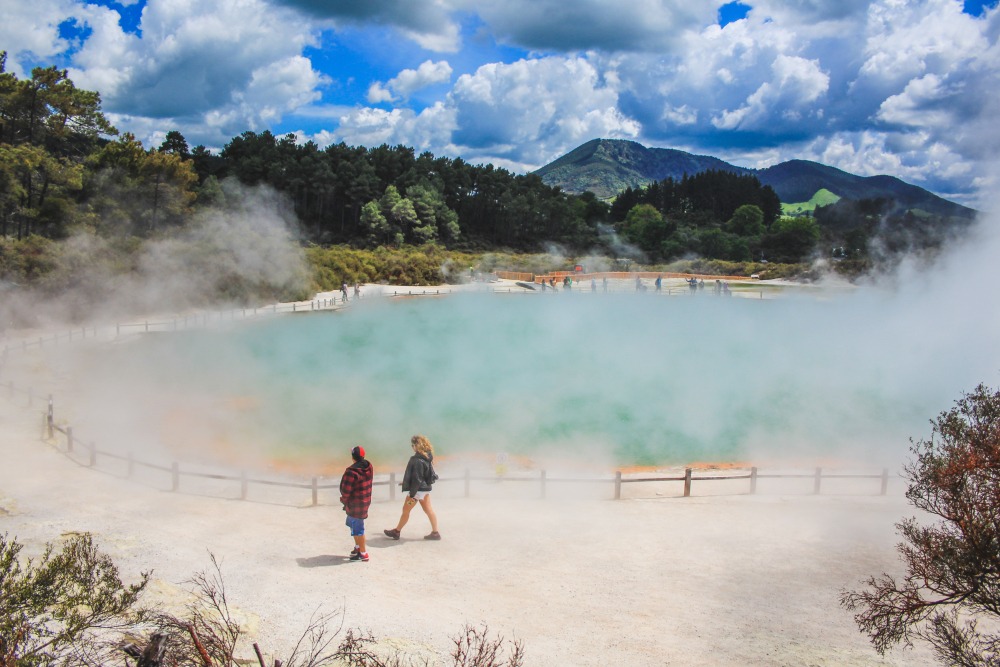
The site covers several hectares of hydrothermal terraces. The silica terraces — nicknamed "The Artist's Palette" — display hues ranging from pure white to ochre and pink depending on mineral deposits. Active geysers erupt at regular intervals. Pools of hot water in turquoise and emerald colors punctuate the trail.
The Ruatapu cave, accessible by stairs carved into the rock, shelters a natural geothermal pool. The Maori traditionally used it to prepare before ceremonies — its name means "sacred cave."
History and Context
The name Orakei Korako roughly means "the place where ornaments are worn" in Maori, referring to ritual practices linked to the cave. The site nearly disappeared in 1961 during the construction of the Ohakuri hydroelectric dam, which submerged part of the original terraces. The area visible today represents about half of the original geothermal field.
Despite this reduction, Orakei Korako remains one of the four major active geothermal fields in the Taupo-Rotorua region, alongside Wai-O-Tapu, Wairakei and Rotorua.
Highlights of Your Visit
The Silica Terraces
Silica deposits form stepped terraces of striking whiteness. Late morning light reveals mineral nuances with the greatest contrast. These formations rank among the most extensive still accessible to the public in New Zealand.
The Geysers and Bubbling Pools
Several geysers erupt regularly along the trail. Gray mud pools and fumaroles complete the picture. Activity varies according to underground conditions — each visit is slightly different.
The Ruatapu Cave
The highlight of the circuit, this cave descends beneath the site's surface. A geothermal pool is visible inside, framed by rocky walls. The atmosphere is radically different from the rest of the park — darker and quieter.
Photography Tips
Mid-morning light is ideal for the silica terraces: it avoids harsh shadows and brings out mineral tones. For geysers, a fast shutter speed freezes water jets. Inside the cave, a tripod or optical stabilization is useful due to low light. Reflections in turquoise pools photograph better on overcast days, without too much contrasting sky reflection.
Location and Access
The park is located about 25 km north of Taupo, on the east bank of the Waikato River. Access is by car via State Highway 1 then a signposted secondary road. No regular public transport serves the site — a rental car is practically essential. Parking is free on the arrival bank; the boat crossing is included in the ticket.
The site is not wheelchair accessible due to wooden walkways and uneven terrain.
Nearby Attractions
- Wai-O-Tapu Thermal Wonderland — colorful geothermal field south of Rotorua, home to the famous Champagne Pool.
- Lake Taupo — New Zealand's largest lake, 25 km to the south, starting point for many water activities.
- Huka Falls — spectacular waterfalls on the Waikato River, a few kilometers north of Taupo.
- Wairakei Thermal Valley — another geothermal site accessible from Taupo, less crowded.
Frequently asked questions
The site is open year-round. The Southern summer (December-February) offers the longest days. In winter, geothermal vapor is more visible in the cold air, which can make photos more dramatic. Avoid days with heavy rain due to slippery walkways.
Advance reservation is generally not required. During peak season (December-January), arriving early in the morning helps you avoid tour groups coming from Rotorua or Taupo.
Orakei Korako is located midway between Taupo and Rotorua. One day is enough to visit the park (2 hours) and reach Rotorua in the late afternoon, provided you start early.
Photos are allowed throughout the park, including in the cave. Bring a stabilized camera or increase ISO to compensate for low indoor light.
Yes, as long as you supervise children at all times on the walkways. Active zones are clearly marked. The boat crossing is generally enjoyed by younger visitors.
Closed non-slip shoes are essential. Pack a light waterproof layer: geothermal vapor can wet your clothes on calm days. In summer, a hat and sunscreen are useful on exposed terraces.
Interested in this visit?
We can include it in your personalised itinerary.