Hokitika
Hokitika
A charming coastal town on New Zealand's West Coast, Hokitika captivates visitors with its sacred jade, turquoise gorges, and a rich gold rush heritage.
Situated on the west coast of New Zealand's South Island, Hokitika is a small coastal town that captivates with its tranquil atmosphere and rich cultural heritage. A former centre of the 19th-century gold rush, it has maintained a strong identity while opening its doors to tourism, blending history, craftsmanship, and breathtaking landscapes. Whether you visit for a few hours or several days, Hokitika promises an authentic and memorable experience at the heart of New Zealand.
Where is Hokitika Located on the West Coast?
Hokitika is the main town in the Westland district and home to its administration. Just some 40 km south of Greymouth (about a 30-minute drive), it sits at the mouth of the Hokitika River and is bordered by the Tasman Sea. This small town lies halfway between Punakaiki's Pancakes Rocks to the north and Fox Glacier further south. Hokitika is also an essential stop for travellers crossing the island from east to west via the spectacular Arthur's Pass.
What Does Hokitika Mean in Māori?
The name Hokitika has its origins in the Māori language and translates to "return directly" (hoki=return, tika=direct). According to tradition, it refers to a significant episode involving Ngāi Tahu warriors. In search of pounamu (New Zealand jade), they were preparing to attack a fortified village of Ngāti Wairangi. However, their chief drowned while attempting to cross the Hokitika River. Deprived of their leader, the army had to abandon the expedition and return directly to their lands, thus giving the place its name.
History
The site of present-day Hokitika was acquired in 1860 by the Crown when Poutini Ngāi Tahu chiefs signed the Arahura Treaty, ceding nearly 3 million hectares of the west coast for £300, with the exception of small Māori reserves.
The discovery of gold in 1864 immediately transformed the town into a thriving mining settlement. Within months, thousands of prospectors from Europe, China, and Australia flooded in, making Hokitika New Zealand's second-largest settlement and one of the major centres of the gold rush.
Hokitika reached its peak in 1866 with an extremely active port: up to 41 ships could dock simultaneously, and it became the country's leading port in both number of arrivals and export value, mainly destined for Melbourne. This situation created tensions with eastern towns, which lost out on the commercial benefits.
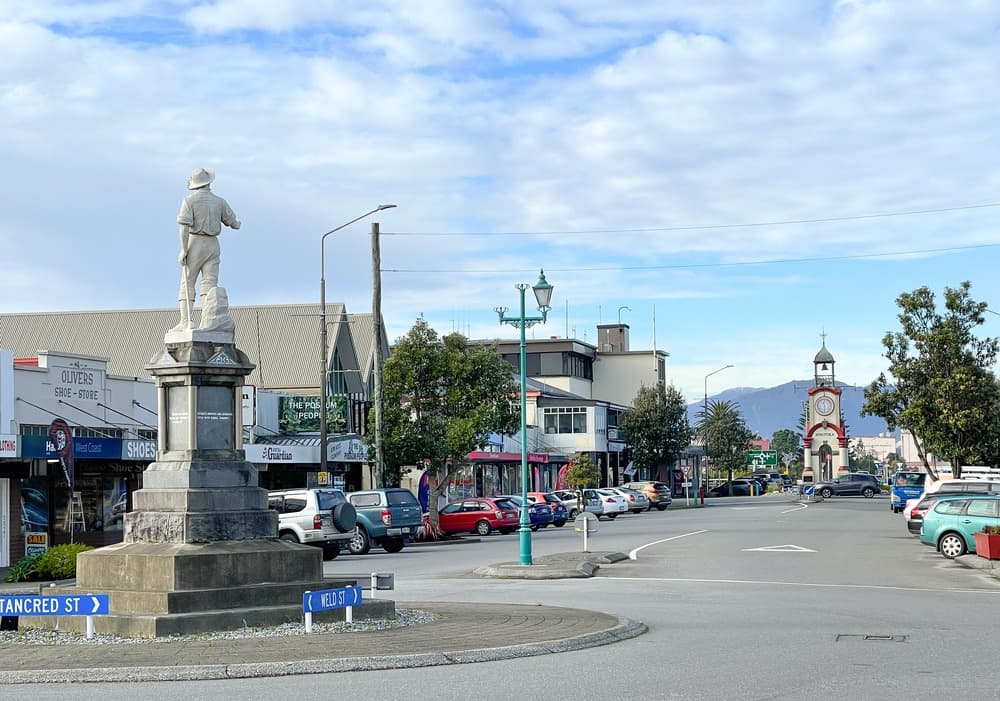
The Jewish community played an active role in this growth: businesses were established and a synagogue was built on Tancred Street. John Lazar, an influential Freemason, was appointed town clerk in 1866. The same period was marked by political and social episodes, such as the funeral ceremony held in 1868 to honour the Manchester Martyrs, which led to the arrest of priest William Larkin.
In 1873, Hokitika became the capital of the Westland province, until the provinces were abolished three years later. The depletion of accessible ore deposits led to gradual decline from 1867 onwards, though gold mining continued for a few more years. In the 1880s, quartz miners from Bullendale and Reefton were even the first in New Zealand to use electricity. The town subsequently diversified with sawmills, flax production, and maritime trade.
In the early 20th century, Hokitika had two medical facilities: Westland Hospital and Seaview Asylum. But its history was darkened in 1941 by the tragedy of Stanley Graham, a farmer who killed 7 people, including several police officers. The manhunt that followed was the largest ever conducted in New Zealand, mobilising over 100 officers and several hundred soldiers. Graham was mortally wounded on 20 October and died the next day.
Subsequently, the town lost importance and became a village, much like Nelson, which was once promised great prospects. However, Hokitika has found a second wind through tourism and pounamu, the Māori sacred jade. Today, its historic buildings, museums, and local artisans' workshops preserve the gold rush heritage, while jade craftsmanship attracts visitors and lovers of symbolic jewellery.
The Treasure of Pounamu
Hokitika is considered the capital of New Zealand jade (pounamu). Used by Māori for centuries to craft weapons, tools, and jewellery, this sacred mineral remains at the heart of local identity. Workshops and galleries allow you to watch local artisans carving pendants shaped like koru (spirals) or manaia (protective creatures), and to acquire unique pieces. Some venues even offer the possibility of creating your own pendant.
What Can You Do and See in Hokitika?
Hokitika Gorge
A true emblem of Hokitika, Hokitika Gorge attracts thousands of visitors each year. Located about 30 kilometres from the town centre, it is accessible via a scenic road dotted with points of interest such as Lake Kaniere and Dorothy Falls.
The gorge is explored via an easy walking track that leads to several viewing platforms and a suspension bridge spanning the Hokitika River. The water, a brilliant turquoise, owes its colour to fine mineral particles from the Southern Alps. This striking contrast with the lush vegetation and rocky cliffs makes it a site of rare beauty, worthy of a postcard.
The circuit, now arranged as a loop, passes through mature forest and along wooden walkways, offering varied and photogenic viewpoints. The walk itself takes only about 15 minutes, but many visitors choose to linger in the surroundings to enjoy the tranquillity of the place.
Hokitika Beach
Facing the Tasman Sea, Hokitika Beach is one of the town's symbols. It features the famous "Hokitika" sign made of driftwood, which has become an iconic photo spot. Visitors enjoy its magnificent sunsets and ephemeral sculptures created from washed-up wood. However, swimming is not recommended due to strong currents. The nearby Sunset Point allows you to observe these natural spectacles in a peaceful atmosphere, often accompanied by a good breakfast on the beach.
Hiking and Discoveries
The region is a playground for outdoor enthusiasts: hiking, kayaking, cycling, fishing, or simple walks along the coastline. Among the must-sees:
- GlowWorm Dell, where thousands of glowworms illuminate the night
- National Kiwi Centre, home to kiwis, tuataras, and century-old giant eels
- Trails such as Mananui Tramline, Mahinapua Walks, or Lake Kaniere Walkway, accessible to all hiking levels.
Culture and Heritage
The Hokitika Museum, housed in the historic Carnegie building, traces the history of the gold rush, pounamu, and early settlers. The Heritage Trail and Westland Industrial Heritage Park further illuminate the local past. The town also abounds with art and craft galleries (pottery, knitting, glassblowing, photography), reflecting a vibrant creative scene. Don't miss the Shipwreck Memorial, a tribute to the historic wrecks that have marked this feared west coast.
Wildfoods Festival and Other Events
Two annual festivals reflect Hokitika's creative and festive spirit:
- The Wildfoods Festival, launched in 1990, attracts over 10,000 visitors keen to taste unusual delicacies (huhu grubs, gull eggs, game, seafood) and enjoy concerts, exhibitions, and parades
- The Driftwood and Sand Festival, during which artists and residents create monumental sculptures from sand and driftwood.
When to Visit Hokitika?
Hokitika enjoys an oceanic climate, characterised by mild summers, cool winters, and evenly distributed rainfall throughout the year. Maximum temperatures reach around 19.9°C in February and 12°C in July, while minimums drop to 12.1°C in February and 3.1°C in July. Summer (December to February) is ideal for hiking, swimming, and festivals. Spring and autumn offer magnificent colours. Winter, though cooler, appeals with dramatic skies and snow-capped mountains, plus the proximity of ski fields.
Hokitika is easily accessible via State Highway 6, which runs through the town from north to south. This scenic route connects Hokitika to Greymouth to the north and Haast to the south, offering a spectacular coastal drive. From Christchurch, it takes approximately 3 hours 30 minutes by car via the impressive Arthur's Pass. Nelson is about 4 hours' drive from Hokitika, following the same main route.
For those preferring air travel, Hokitika Airport, located at Seaview, operates two daily flights of approximately 35 minutes to Christchurch with Air New Zealand, facilitating connections with the rest of the country.
FAQ
Is Hokitika a Good Place to Live?
Yes, Hokitika is a good place to live if you seek a peaceful town close to nature, with a strong local community, an exceptional wild setting, and reasonable cost of living.
What is New Zealand's Emblematic Stone?
New Zealand's emblematic stone is pounamu (New Zealand jade), a sacred stone to Māori, used for centuries to craft jewellery, tools, and ceremonial objects.
Want to discover this destination?
Our local advisors design your tailor-made trip.