Punakaiki
Punakaiki
On the South Island's West Coast, Punakaiki brings together the Pancake Rocks, spectacular blowholes and access to Paparoa National Park.
Punakaiki is a coastal village on New Zealand's West Coast, located on the South Island between the Tasman Sea and the Paparoa Range. Its fame rests on a singular geological site, the Pancake Rocks, but also on its position as a gateway to Paparoa National Park, its forest trails and its coastal biodiversity.
Why visit Punakaiki
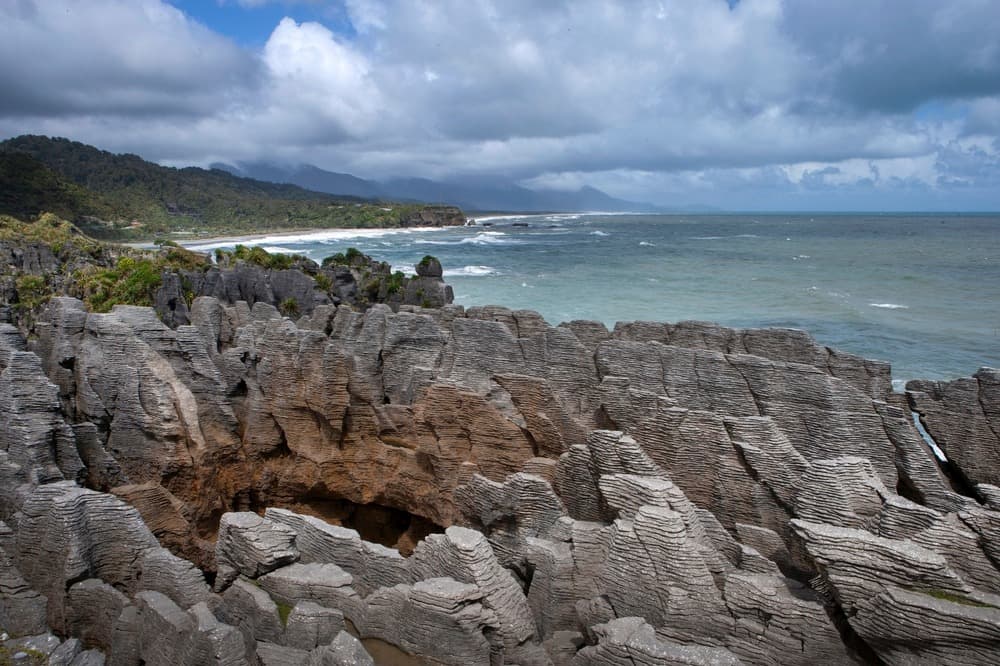
Three elements set Punakaiki apart from other West Coast stops. First, the limestone formations at Dolomite Point, 30 million years old, whose alternating layers of hard limestone and soft sediment evoke stacks of pancakes piled high. Next, the blowholes that shoot seawater into geysers at high tide. Finally, a remarkable endemic fauna, including the Westland petrel, a seabird that breeds nowhere else in the world.
The village remains modest in size, making it more of a stopover than a prolonged base, except for hikers wanting to tackle multiple trails in Paparoa National Park.
History and Māori heritage
The name Punakaiki is of Māori origin. It likely means "source of food," referring to the abundance of marine and forest resources exploited by local communities. An alternative hypothesis sees it as a phonetic adaptation of the English word "pancakes," later than European colonisation and linked to the famous rock formations.
The region belongs to the ancestral territory of Ngai Tahu, the principal iwi (tribe) of the South Island. Knowledge of tides, seasonal cycles and plant species long structured fishing, gathering and ritual practices. First European contacts date to the late 18th century with James Cook's expeditions, but effective settlement on the West Coast goes back to the 19th century, driven in particular by the gold rush.
Further back in time, limestone caves in the area have yielded fossils roughly 25,000 years old: bones of moas, amphibians and reptiles dating to the Otira glaciation, shedding light on the region's past fauna.
What to see and do
Pancake Rocks and blowholes
The Pancake Rocks & Blowholes Walk trail runs through native forest to Dolomite Point. The short walk, partly accessible to wheelchairs, is marked with information panels on rock formation and the mechanism of the blowholes. To see the geysers in action, aim for high tide during rough seas: without swell, the phenomenon remains subtle.
Punakaiki Cavern
Just minutes from the village, this limestone cave is free to visit. A wooden staircase gives access to roughly 130 metres of galleries, where you can observe stalactites and glow worms. A headlamp is essential.
Trails in Paparoa National Park
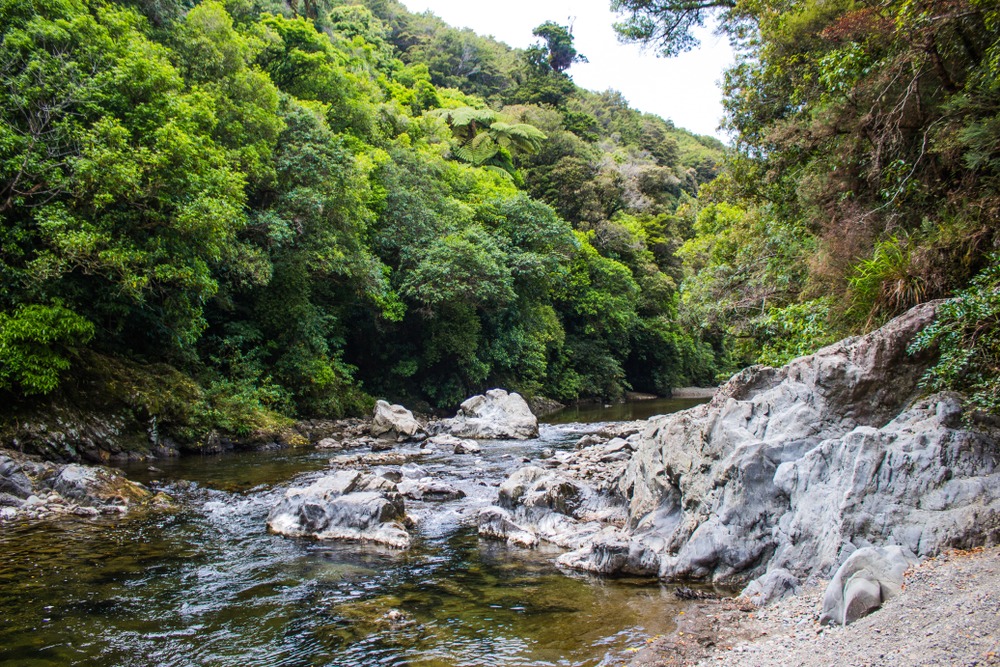
- Pororari River Track: forest trail following a pristine river framed by limestone cliffs and nikau palms.
- Truman Track: short trail descending to an isolated beach and coastal waterfall.
- Paparoa Track: one of New Zealand's Great Walks, doable over several days on foot or by mountain bike.
- Ballroom Overhang Track and Inland Pack Track: longer and more technical routes, best left to experienced and well-equipped walkers.
Fauna and flora
The coastline is home to fur seals and, offshore, Hector's dolphins. Bird-wise, you'll spot weka, tūī, bellbird, piwakawaka (collared fantail), kererū (endemic pigeon) and several cormorant species. The Westland petrel nests in protected colonies with restricted access. Launched in 2009, the Punakaiki Coastal Restoration Project works to regenerate 40 hectares of coastal sand forest, where nikau palms, surprising at this latitude, thrive among other plants.
Kayaking and horseback riding
Local operators offer kayaking on the Pororari River, framed by cliffs and dense vegetation, as well as horse rides along the Punakaiki River to the beach.
Practical information
Allow 1 to 2 hours for the Pancake Rocks loop with photo stops, a half-day to combine Pancake Rocks, Truman Track and Punakaiki Cavern, and a full day if you add the Pororari River Track. The main Dolomite Point trail is partially wheelchair accessible; other tracks are more demanding natural trails.
The village has an information centre, a few lodgings and restaurants, but the offer remains limited. Plan for fuel, cash and supplies from Greymouth or Westport.
When to go
The ideal season runs from November to April, during the southern summer. Days are long, temperatures range between 10 and 22 °C and rainy spells are less frequent than in winter. The climate remains damp and oceanic year-round: a waterproof jacket is useful in all seasons. Frosts are rare, making off-season visits possible for those comfortable with changeable skies.
How to get there
Punakaiki sits on State Highway 6, roughly 46 km north of Greymouth and 56 km south of Westport. By car, count around 45 minutes from Greymouth and just over an hour from Westport. The route hugs the ocean and ranks among the most scenic road stretches on the South Island.
Without a vehicle, InterCity buses serve the village. A drop-off at Truman Track lets you start your visit with this trail before walking on to Dolomite Point.
Nearby
To the north, Cape Foulwind, near Westport, offers a coastal trail to a seal colony. Further south, Franz Josef provides access to one of New Zealand's most visited glaciers. Heading north-east, the Marlborough Sounds offer a jagged coastline ideal for kayaking. Paparoa National Park, which borders Punakaiki directly, deserves a full day in itself.
FAQ
Frequently asked questions
A half-day is enough for Pancake Rocks, Truman Track and Punakaiki Cavern. Allow a full day to add the Pororari River Track, and several days if you want to walk the Paparoa Track.
The blowholes are most spectacular at high tide during rough seas, with sustained westerly winds. Check local tide times before your visit. The season from November to April offers the most comfortable visiting conditions.
The Pancake Rocks & Blowholes trail is partially wheelchair accessible. Punakaiki Cavern, however, requires using a wooden staircase, and the park's other trails are unformed natural tracks.
Yes. InterCity buses linking Greymouth to Westport stop there daily. A drop-off at Truman Track lets you link the trail and main site on foot.
Plan your trip
Punakaiki fits naturally into a South Island itinerary, between the West Coast, glaciers and Tasman coast. To build your custom journey, check out our New Zealand trips.
Interested in this visit?
We can include it in your personalised itinerary.