Banks Peninsula in New Zealand
Banks Peninsula in New Zealand
1.5 hours from Christchurch, Banks Peninsula brings together volcanic calderas, the Franco-New Zealand port of Akaroa, Hector's dolphins and coastal trails.
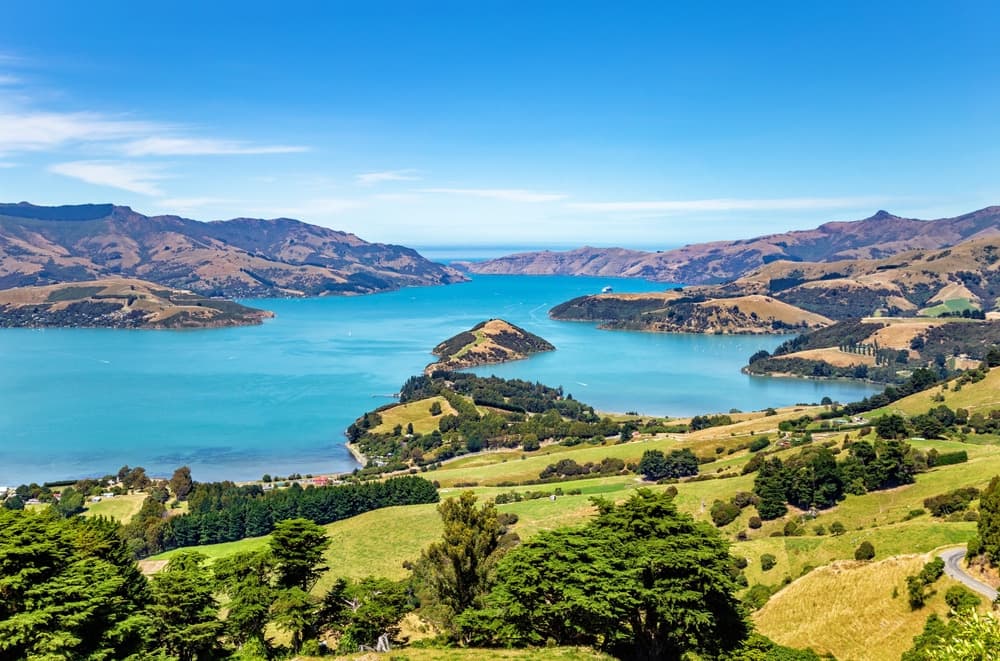
East of Christchurch, Banks Peninsula extends nearly 50 km into the South Pacific Ocean. This promontory of roughly 1,300 km², shaped by two extinct volcanoes, stands in stark contrast to the flat Canterbury plains that surround it. Rugged ridges, deep bays, Māori heritage and French traces make this territory one of the most rewarding day trips from Christchurch.
Why visit Banks Peninsula
The peninsula brings together several faces of the South Island within a compact space: natural harbors born from volcanic calderas, villages with distinctive character, coastal trails and marine wildlife. Akaroa cultivates a unique Franco-New Zealand identity found nowhere else in the country, a legacy of the attempted French colonization in the 1840s. The sheltered waters of Akaroa Harbour allow observation of Hector's dolphins, one of the world's smallest cetacean species and endemic to New Zealand. Add to this the immediate proximity to Christchurch, which makes it an accessible day trip or a multi-day escape.
Geography and volcanic past
The peninsula is part of the Canterbury region. Bordered by Pegasus Bay to the north and Canterbury Bight to the south, it is bounded to the west by Lake Ellesmere / Te Waihora. Mount Herbert, the highest point, rises to 918 meters above sea level.
Its geological history stretches back over 10 million years, to the Miocene. Two vast volcanoes rose offshore from the South Island, forming an isolated volcanic island. Their collapsed calderas correspond today to the two natural harbors of Lyttelton and Akaroa. Over time, sediment carried by the Waimakariri River filled the gap between this island and the mainland, forming the Canterbury plains and joining the peninsula to the South Island. On the north and west slopes, wind-deposited loess gradually shaped the current landscape, now dominated by pastureland where dense native forest once spread.
History and cultural heritage
Before European arrival, the peninsula experienced several waves of Māori settlement: first the Waitaha, then the Kati Mamoe, and finally the Ngai Tahu, whose presence is documented from the 17th-18th centuries. These populations lived from fishing, bird hunting and the gathering of seafood (kai moana), and established pā (fortified villages) notably at Akaroa and Wainui. Many Māori place names remain, and several sites retain spiritual significance for their descendants.
In 1770, James Cook sighted the peninsula from the sea. Deceived by its silhouette, he named it "Banks Island" in honor of botanist Joseph Banks, thinking he had encountered an island. In the early 19th century, the natural harbors attracted whalers and seal hunters. In the 1830s, Captain Jean-François Langlois negotiated the purchase of land with the Māori at Akaroa, with a view to founding a French colony. In 1840, the signing of the Treaty of Waitangi placed New Zealand under British sovereignty just before the arrival of French colonists led by Charles-François Lavaud. These settlers established themselves nonetheless at Akaroa, under British administration. Akaroa remains today the only town in the country to claim a Franco-New Zealand identity, evident in its street names, architecture and cuisine.
What to see on the peninsula
Akaroa
The port of Akaroa, nestled at the head of a flooded caldera, concentrates most of the tourist appeal. Art galleries, seafood restaurants, lanes bearing French names and a sheltered waterfront create a singular atmosphere. It is also the departure point for Hector's dolphin watching excursions.
Lyttelton
Christchurch's principal port, Lyttelton occupies another former caldera, accessible from the city via a road tunnel cutting through the hills. Marked by its maritime past and its role as gateway to Antarctica, the town has retained a strong cultural identity, with a reputed Saturday morning market.
Little River
Nestled in the hills, Little River serves as the arrival point for the Little River Rail Trail, a 45 km cycling track from Christchurch. The village is home to a local art gallery and a few cafés, with a rural character.
Okains Bay
This isolated bay is known for its long beach, its estuary and its Māori and colonial museum. Okains Bay hosts the Waitangi Day celebrations each year, among the oldest on the South Island.
What to do there
Hiking
The Banks Peninsula Track offers a private 3-day itinerary alternating between cliffs, isolated beaches, native forests and pastureland. Hinewai Reserve, a regenerating conservation area, offers shorter trails through recovering forest. The Summit Road, which follows the crest of the former calderas, provides access to viewpoints over both harbors.
Marine wildlife and nautical activities
Cruises departing from Akaroa allow observation of Hector's dolphins, as well as fur seals and little penguins depending on the season. Sea kayaking in Akaroa Harbour and swimming in sheltered coves (Governors Bay, Le Bons Bay) round out the nautical options.
Night sky
Far removed from major urban areas, the peninsula offers good conditions for stargazing, particularly from the heights of the Summit Road.
Practical information
Allow at least a full day to discover Akaroa and the scenic drive, two to three days to explore the bays of the east coast and attempt a hike. The main road to Akaroa winds its final section: plan for roughly 1.5 hours of driving from Christchurch. Secondary roads serving the bays (Okains Bay, Le Bons Bay) are narrow and sometimes unsealed. Varied accommodations in Akaroa and Lyttelton, scarcer in the isolated bays: book in advance during high season. Prices are generally higher than elsewhere in Canterbury, especially in Akaroa.
When to visit
The Austral summer (December to February) offers the most favorable conditions for swimming, kayaking and coastal trails, with mild temperatures and long days. Early spring (September-October) sees the slopes covered in wildflowers, with lighter crowds. Autumn (March-May) remains pleasant and luminous. Winter is wetter and windier, but the Summit Road can then offer clear views of the snow-capped Southern Alps.
How to get there from Christchurch
The peninsula is reached by car from Christchurch via State Highway 75, heading toward Akaroa: approximately 75 km, or 1.5 hours of driving. Lyttelton is accessible in about twenty minutes from the city center, via the Lyttelton road tunnel. Tourist shuttles connect Christchurch to Akaroa daily during high season. Renting a car remains the most flexible solution to access the isolated bays and the Summit Road.
Nearby
From the peninsula, several essential stops on the South Island are within reach. Christchurch is the natural logistical base. To the west, Arthur's Pass National Park allows you to swing toward the west coast through the Southern Alps. Further on, Cape Foulwind and its fur seal colonies mark the western extremity of the island.
FAQ
Frequently asked questions
Yes. It resulted from the successive eruption of two volcanoes during the Miocene, more than 10 million years ago. Their collapsed calderas form today's natural harbors of Lyttelton and Akaroa.
One day allows you to discover Akaroa and the scenic drive. Allow 2 to 3 days to explore the bays of the east coast, and 3 full days to walk the Banks Peninsula Track.
Hector's dolphins are present year-round in Akaroa Harbour, but sea trips are more regular and conditions more favorable between October and April.
In 1840, Captain Jean-François Langlois purchased land from the Māori to establish a French colony. The arrival of colonists led by Charles-François Lavaud coincided with the signing of the Treaty of Waitangi placing New Zealand under British sovereignty. The French settled nonetheless, leaving behind street names, architecture and culinary traditions.
Tourist shuttles connect Christchurch to Akaroa daily, especially during high season. Lyttelton is served by Christchurch's urban buses. To explore the isolated bays, a car is essential.
Prepare your trip
Banks Peninsula fits naturally into an itinerary on the South Island, complementing Christchurch and the Southern Alps. To design a bespoke trip incorporating this stop, explore our New Zealand travel offering.
Interested in this visit?
We can include it in your personalised itinerary.