Kaitoke Regional Park
Kaitoke Regional Park
Just 50 minutes from Wellington, Kaitoke Regional Park encompasses 2,860 hectares of native forest, trails, rivers and the Rivendell filming site.
About 50 minutes' drive north of Wellington, Kaitoke Regional Park spans approximately 2,860 hectares of native forests and gorges at the foot of the Tararua Range. Located near Upper Hutt, it combines hiking trails, river swimming, rustic camping and an iconic filming location from The Lord of the Rings.
Why visit Kaitoke Regional Park
Kaitoke brings together several points of interest rarely found on a single site: an ancient forest dominated by rātā, rimu, hinau and red and black beech trees, natural pools along the Hutt River (Te Awa Kairangi) and the Pakuratahi, as well as the setting where Peter Jackson recreated Rivendell. The park is open year-round, entry is free and the trails suit both families and experienced hikers.
Its proximity to Wellington makes it an accessible day trip, but camping also allows you to extend your stay on site. Birdwatching for endemic species — tūī, kererū, pīwakawaka (fantail), korimako (bellbird), miromiro (tomtit) and kākā (forest parrot) — is regular here.
History of the site
Before European arrival, the territory was traversed by the iwis Te Atiawa and Ngati Raukawa, and earlier by Ngati Ira. Traditional trails connected the Wairarapa to Wellington Bay, and the Hutt River served as a waka (canoe) navigation route. The pā of Whakataka, located at Te Marua, is believed to have been established before 1820; its remains are found south of the park.
A road was opened in 1856 by European settlers, who exploited timber and cleared part of the forests. In 1939, parcels of intact forest were acquired to protect water resources. On 20 November 1951, additional land was incorporated to create the Hutt water catchment area. In 1976, regional authorities proposed transforming the site into a regional park, officially opened in 1983.
The Wellington Botanical Society and the local branch of Forest and Bird (Upper Hutt) are involved in conservation efforts. In August 2021, a wheelchair-accessible suspension bridge was inaugurated over the Te Awa Kairangi/Hutt River, alongside an ecological restoration programme aimed at strengthening the park's carbon sink function.
What to see and do
Hiking trails
The marked trail network suits all abilities:
- Pakuratahi River Walk: easy walk along the river.
- Swingbridge Track: approximately 2 km loop passing the suspension bridge over the Hutt River, beneath the canopy of century-old rimu and rātā trees.
- Ridge Track: more challenging route, allow about 3.5 hours return.
- Remutaka Rail Trail: 17 km along a former railway line, accessible to walkers and cyclists alike.
The Rivendell filming site
It was in Kaitoke forest that Peter Jackson recreated Rivendell for the Lord of the Rings trilogy. Some areas of the park also represented the Fords of Isen. The filming sets were dismantled, but a dedicated walkway, explanatory panels and a symbolic replica of the elvish gate mark the key locations.
Swimming and kayaking
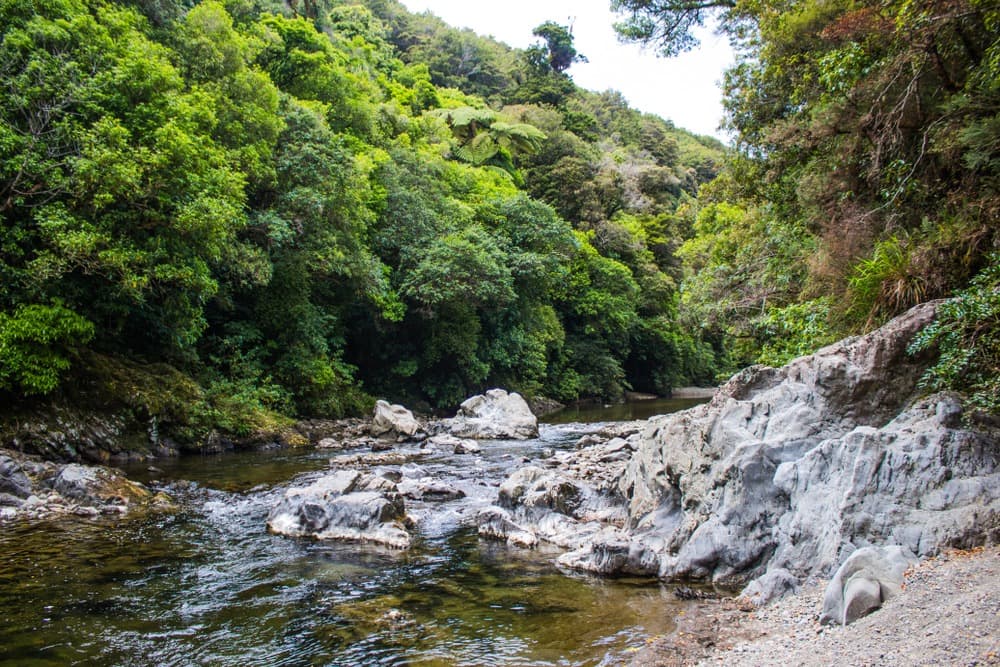
The Hutt and Pakuratahi rivers offer natural pools usable in summer. The Hutt, deeper, suits experienced swimmers; the Pakuratahi, calmer, is suitable for children. The Hutt gorges feature grade 3 rapids frequented by experienced kayakers.
Camping
The main camping area has 6 powered sites, 4 BBQ shelters (one bookable for groups), drinking water, picnic areas and a covered kitchen. There are no showers on site. Campfires are allowed only on river beds, with prior permission. Payment is made to the ranger who calls by in the evening.
When to visit
The park can be visited year-round, but each season offers a different experience:
- Summer (December-February): ideal period for swimming in natural pools and camping. Days are long and trails are dry.
- Autumn (March-May): mild temperatures, fewer visitors, good hiking conditions.
- Winter (June-August): trails sometimes muddy, rivers cold; swimming is not recommended but walking remains pleasant in dry weather.
- Spring (September-November): forest particularly lively for birdwatching, river flow more sustained.
Opening hours vary by season (extended morning-evening in summer, reduced in winter); it's best to check before leaving, knowing that traffic within the park is prohibited late at night.
How to get there
By car from Wellington
Allow approximately 50 minutes via State Highway 2, outside peak hours. Two main entrances:
- Waterworks Road entrance: 12 km north of Upper Hutt, free parking.
- Te Marua entrance (Twin Lakes Road): 5 km north of Upper Hutt, access to mountain bike trails.
By train and bus
Take the train to Upper Hutt station, then bus 112 towards Te Marua. Get off at Te Marua Store stop, then allow about 1 km walk along SH2 to the park entrance.
By bike
The park is accessible via the Hutt River Trail, integrated into the Greater Wellington cycle network. Rental and shuttle services are available on site.
Nearby attractions
If you extend your exploration of New Zealand, several parks and natural sites offer an interesting complement to Kaitoke:
- Fiordland National Park for the spectacular fjords of the South Island.
- Arthur's Pass National Park to traverse the Southern Alps.
- Banks Peninsula near Christchurch, volcanic landscapes and bays.
- Cathedral Cove on the Coromandel Peninsula.
FAQ
Frequently asked questions
Planning your trip
Kaitoke Regional Park fits easily into an itinerary in the Wellington region, at the beginning or end of a stay on the North Island. To build a tailor-made trip including this site and other natural parks, consult our suggestions for travel in New Zealand.
Interested in this visit?
We can include it in your personalised itinerary.