Milford Sound/Piopiotahi
Milford Sound/Piopiotahi
An iconic fjord on New Zealand's South Island, Milford Sound/Piopiotahi combines towering cliffs, waterfalls, and unique wildlife in the heart of UNESCO-listed Fiordland.
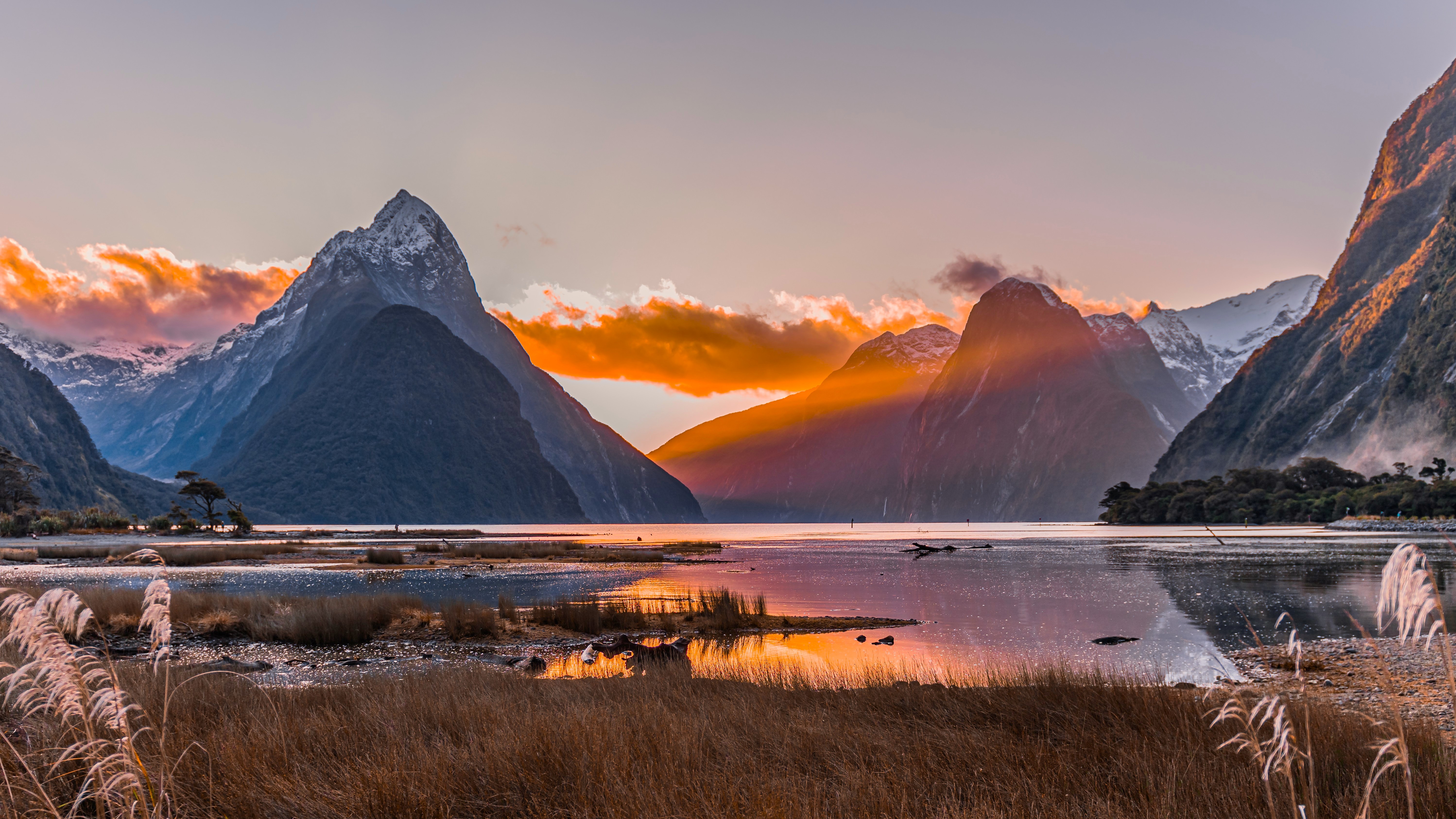
Milford Sound/Piopiotahi is a fjord on New Zealand's South Island, located in the far southwest within Fiordland National Park. Stretching approximately 15 to 16 km from the Tasman Sea, it cuts between near-vertical walls crowned by Mitre Peak (1,683 m). Inscribed as a UNESCO World Heritage Site under the name Te Wahipounamu, it ranks among the country's most visited natural sites and is the only New Zealand fjord accessible by road.
Why visit Milford Sound
Milford Sound's uniqueness lies in the combination of its dramatic relief, climate, and ecosystem. The cliffs plunge vertically into waters exceeding 400 metres in depth. With approximately 7 metres of rainfall annually, rain is an almost daily phenomenon: it feeds hundreds of temporary waterfalls cascading down the walls, alongside two permanent falls, Lady Bowen Falls and Stirling Falls. Whether shrouded in rain or bathed in clear skies, the fjord presents two strikingly different faces, making it one of New Zealand's most photographed landscapes.
Rudyard Kipling is said to have called it the "8th wonder of the world"—a phrase that has clung to the site ever since. Beyond the imagery, Milford Sound offers a rare concentration of natural phenomena accessible within hours: marine wildlife, temperate rainforests, alpine peaks, and distinctly unusual submarine environments.
History and Maori heritage
The fjord was frequented nearly 1,000 years ago by the first Maori to arrive on the South Island. They came to fish, hunt, and above all to harvest pounamu, a green stone similar to jade and sacred to their culture. The site was never permanently settled by local tribes, though they possessed intimate knowledge of its tides and terrain.
James Cook approached the fjord in 1770 aboard the Endeavour but, deeming the entrance too narrow and treacherous for his sailing ship, did not venture in. It wasn't until 1823 that John Grono, a Welsh-born sealer, actually explored the area and christened it Milford Haven, after his native port in Wales. The name would later evolve into Milford Sound.
The first permanent resident was Donald Sutherland, a Scottish goldseeker who settled on the fjord's shores in 1877. He discovered Sutherland Falls and opened the region's first hotel, welcoming hikers on the Milford Track, inaugurated in 1888 after the discovery of Mackinnon Pass. The fjord's isolation long hindered development: it was not until 1954, with the opening of the Homer Tunnel after 25 years of construction, that the site became accessible by road.
In 1990, Milford Sound and all of Fiordland National Park were inscribed on the UNESCO World Heritage List under the name Te Wahipounamu. The dual designation Milford Sound/Piopiotahi became official in 1998, acknowledging the site's significance for both Maori and European peoples.
What to see and do
The landscape and waterfalls
Mitre Peak rises to 1,683 metres, while The Lion (1,517 m) and The Elephant (1,302 m) earn recognition through their distinctive silhouettes. The two permanent waterfalls, Lady Bowen Falls and Stirling Falls, are best observed at close range during cruises.
An atypical marine ecosystem
Heavy rainfall creates a layer of freshwater tinged with tannins that floats atop saltwater. This peculiarity reduces light penetration and allows black coral to thrive as shallow as 10 metres below the surface, whereas it normally grows much deeper. Milford Sound is thought to harbour one of the world's most significant black coral populations, alongside red coral and the spectacular bubblegum coral, which can reach 7 metres in height.
Marine life and birds
The fjord's waters shelter a resident population of bottlenose dolphins and New Zealand fur seals, often visible at Seal Point. Among birds, the temperate rainforests host the kea (an inquisitive and opportunistic alpine parrot), the southern takahé, long believed extinct, and the whio (blue duck), spotted at Monkey Creek or in the Eglinton Valley. The kakapo, a flightless owl-parrot, is associated with the region though current populations are confined to island sanctuaries. Two penguin species frequent the fjord, including the Fiordland crested penguin (tawaki, or rockhopper), identified by its distinctive blonde feathers above the eyes.
Visiting options
By cruise. This is the most common option. Several operators, including RealNZ and Southern Discoveries, offer outings ranging from day trips to overnight stays aboard. A typical cruise lasts approximately 1.5 to 2 hours.
By kayak. For a quieter approach, Rosco's Milford Kayaks offers guided excursions, sometimes combined with a cruise.
From the air. Scenic flights by plane or helicopter depart from Queenstown and Te Anau, occasionally including glacier landings.
On foot. The legendary Milford Track is a 4-day hike suited to experienced walkers and requires advance booking. For more accessible options, the Foreshore Walk, Milford Sound Lookout Track, and Key Summit Track deliver fine views without significant difficulty.
Practical information
- Duration: from a half-day cruise to 4 days for the Milford Track.
- Rates: day cruises fall within a moderate range; scenic flights and overnight cruises are considerably more expensive.
- Booking: highly recommended during peak season (December to February); essential for the Milford Track.
- Gear: waterproof and windproof clothing even in summer, as rain can strike at any moment.
When to visit
The fjord welcomes visitors year-round. The Australian summer (December to February) offers the mildest temperatures and longest daylight hours, but it's also peak season. Spring (October–November) and autumn (March–April) remain pleasant with fewer crowds. Winter (June–August) sees calmer, damper conditions, yet snow-capped peaks magnify the scenery; some high-altitude trails may close and the Milford Road can face avalanche-related restrictions. Whatever the season, prepare for rain—it's what reveals the temporary waterfalls.
Getting there
Milford Sound has only one land access: State Highway 94, known as Milford Road. From Queenstown, allow approximately 4 hours, crossing the Remarkables, skirting Lake Wakatipu, then passing through the Homer Tunnel, which opens into the fjord valley. From Te Anau, the journey is considerably shorter (roughly 2 hours). Those preferring not to drive can opt for shuttles and guided tours departing from Queenstown, Te Anau, and Dunedin, typically including the cruise.
What to do nearby
Te Anau, approximately 2 hours' drive away, serves as an ideal logistical base and provides access to the glowworm caves and the lake of the same name. Doubtful Sound, Fiordland's second major fjord, offers a wilder, less-visited experience than Milford. Queenstown, departure point for most excursions, concentrates lodging and adventure activities. To extend your South Island exploration, Franz Josef glacier and Cape Foulwind fit naturally into a West Coast itinerary.
FAQ
Frequently asked questions
The name Piopiotahi means "one piopio," named for a now-extinct bird species. According to legend, a piopio came to mourn the death of the divine hero Māui at this location. Another tradition credits the fjord's creation to Tū-te-raki-whānoa, who carved the cliffs with his axe Te Hamo while reciting a karakia (sacred prayer).
The phrase is attributed to writer Rudyard Kipling, who was reportedly struck by the fjord's beauty. While the exact source of the quote remains debated, the expression has become synonymous with the site due to its rare combination of deep fjords, sheer cliffs, and waterfalls.
A standard cruise lasts roughly 1.5 to 2 hours. Departing Queenstown on a day trip, allow 12 to 13 hours total including the cruise. Staying overnight in Te Anau allows you to reach the fjord earlier in the morning, when light and tranquility are optimal.
Yes, especially during peak season (December to February). The Milford Track, subject to quota limits, must be reserved several months ahead. Cruises and shuttles can typically be booked a few days before during the off-season.
Milford Sound is more accessible, visually more dramatic, and thus more crowded. Doubtful Sound, larger and more remote, is reached only by boat via Lake Manapouri, making it a wilder experience but requiring a full day of logistics.
Incorporate Milford Sound into your journey
Milford Sound is one of the highlights of a South Island circuit, best combined with Queenstown, Te Anau, and the West Coast. Explore our tailor-made itineraries in New Zealand to add the fjord to your programme.
Interested in this visit?
We can include it in your personalised itinerary.