Kura Tawhiti (Castle Hill)
Kura Tawhiti (Castle Hill)
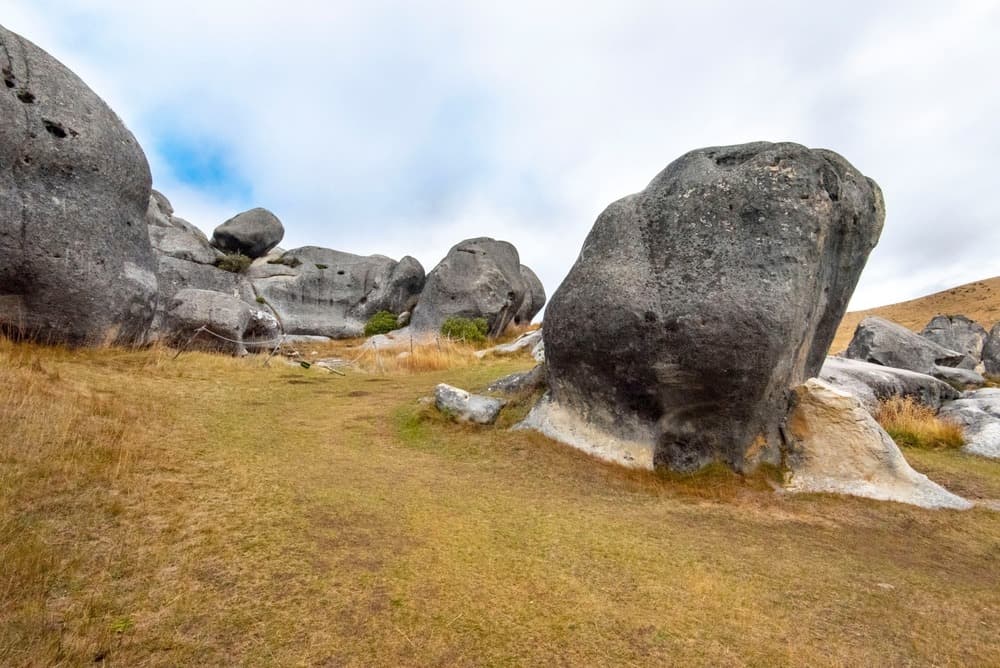
Limestone blocks sculpted by erosion, Tōpuni site of the Ngāi Tahu and world-renowned bouldering spot: Kura Tawhiti is freely accessible 1h15 from Christchurch.
Kura Tawhiti, better known by its European name Castle Hill, refers to an alignment of massive limestone blocks rising from a grassy plain in the Canterbury region, on the South Island of Nouvelle-Zélande. At approximately 700 metres above sea level, these karstic formations evoke the ruins of a castle, hence their colonial name. The site combines geological interest, cultural significance for the Ngāi Tahu, endemic botany and terrain recognised worldwide for bouldering.
Why visit Kura Tawhiti
The site brings together multiple interests rarely found in one place. Geologically, it is a karstic landscape formed on marine sediments 30 to 40 million years old. Culturally, it is a Tōpuni land protected on behalf of the Ngāi Tahu people, who left rock paintings and petroglyphs dated over 500 years ago. Botanically, the area is home to Castle Hill buttercup (Ranunculus paucifolius), a strict endemic. Athletically, it is one of the most renowned bouldering spots in the Southern Hemisphere. Access is free, parking is complimentary, and a looped trail of about ten minutes allows visitors to reach the rocks, some of which reach 50 metres in height.
A karstic formation born beneath the sea
The present-day plain of Kura Tawhiti was once submerged beneath a vast inland sea, the Waimakariri basin. The rocks at the site (tertiary limestone, sandstone, mudstone and tuff) formed from organic sediments deposited in the ocean depths 30 to 40 million years ago. Once compacted, these deposits produced soft, soluble limestone, typical of karstic landscapes.
With the retreat of the sea, tectonic movements lifted and folded the region, giving rise to the Tortelesse and Craigieburn ranges that now frame the site. Erosion subsequently sculpted the limestone into arches, slabs and towers. Marine fossils remain visible in some rocks. The limestone from the region was also used locally as a building stone, particularly for the facade of Christchurch Cathedral.
Sacred land for the Ngāi Tahu
The name Kura Tawhiti means "the treasure of a distant land" or "the treasure of ancient times". It refers to the kūmara, a sweet potato of tropical origin once cultivated in the region, and more broadly to ancestral knowledge linked to the territory.
Long before the arrival of Europeans, the site served as a passage point, gathering place and place of learning. Shelters adorned with rock paintings and petroglyphs attributed to Waitaha ancestors, dated over 500 years ago, can still be found here. A traditional flax and wood backpack, discovered in the heights, also testifies to this ancient occupation. The region is linked to several tribal narratives, notably that of Tāne Tiki, son of chief Tūāhuriri, who came here to collect kākāpō feathers intended for his daughter Hine Mihi.
Since 1998, Kura Tawhiti has enjoyed dual status: public conservation area and Tōpuni. The latter, derived from a custom in which a chief symbolically spreads his cloak over a place, ensures legal recognition of the cultural and spiritual values of the Ngāi Tahu and their active role in managing the site. Visitors are required to respect the Department of Conservation (DOC) code of conduct: drones are prohibited, marking of rocks is forbidden, and visitors are asked to remain on the trails.
What to see and do on site
Walking between the blocks
A looped trail of approximately ten minutes departs from the carpark and winds through the limestone formations. The terrain is flat, accessible to everyone, and allows free movement between rocks that can reach 50 metres high. Several blocks hold cultural value for the Ngāi Tahu: it is essential to respect the marking and not to climb where prohibited. Dogs are not permitted.
Bouldering, an international reputation
Castle Hill is recognised worldwide for bouldering, that is to say climbing blocks without ropes. Climbers come here to work on rock reading and balance rather than pure physical strength. Equipment is limited to crash pads and chalk; ropes are forbidden. Each person climbs independently, in respect of the DOC code of conduct. The famous Run and Jump Slab, a popular sloping slab, is also regularly used by children for fun at the foot of the blocks.
Exceptional botany
The present-day landscape results from an ecological upheaval. A fire ravaged native vegetation about 600 years ago, followed by approximately 150 years of grazing that profoundly altered the vegetation cover. Tussocks and sparse pasture now dominate, with only one tōtara visible nearby.
The site nonetheless shelters several plants among the most threatened on the South Island, starting with Castle Hill buttercup (Ranunculus paucifolius), a strict endemic. Thanks to the work of Dr Lance McCaskill, the site was designated in 1954 as Nouvelle-Zélande's first botanical reserve created to protect a plant. Renamed in 1967 Lance McCaskill Nature Reserve, this area of approximately 6 hectares now contains, according to surveys, only a few dozen individuals of the buttercup. Other rare species share this habitat: Castle Hill forget-me-not (Myosotis colensoi), a dwarf sedge of 3 cm (Carex inopinata) and an endemic limestone wheat (Australopyrum calcis subsp. obtatum).
A film set
Contrary to popular belief, The Lord of the Rings was not filmed at Castle Hill. However, the final battle scenes of The Chronicles of Narnia: The Lion, the Witch and the Wardrobe (2005) were filmed nearby, on the neighbouring Flock Hill station. The latter, also rich in limestone formations, requires prior online registration, unlike Kura Tawhiti, which remains freely accessible.
Practical information
- Access: free and open, carpark with toilets on the State Highway 73.
- Main trail: looped route of about ten minutes, flat terrain, accessible without particular physical condition. Good footwear recommended.
- Duration of visit: allow 1 to 2 hours for a leisurely walk, more for climbers.
- Bouldering: crash pads and chalk only, ropes prohibited.
- Rules: drones prohibited, no marking on rocks, dogs not permitted, respect of Tōpuni markings.
When to go
Kura Tawhiti can be visited year-round, but the alpine setting requires certain precautions. At 700 metres altitude, winters (June to August) are cold, with frequent morning frost and possible snow on the rocks and State Highway 73. The road generally remains open but may require chains after snowfall: check conditions on the NZTA website before departure. Spring (September-November) and autumn (March-May) offer the mildest temperatures and soft light appreciated by photographers. Summer (December-February) is the peak tourist season, with the site noticeably busier in mid-day; an early morning or late afternoon visit remains more pleasant. Wind can be steady in all seasons on this exposed plateau.
How to get there
Kura Tawhiti is located along State Highway 73, also called the Great Alpine Highway, between Springfield and Arthur's Pass. This scenic route crosses the Southern Alps and connects the east coast to the West Coast.
- From Christchurch: approximately 1 hour 15 minutes' drive west.
- From Arthur's Pass: approximately 45 minutes.
- From Greymouth (west coast): approximately 2 hours.
- From Queenstown: approximately 6 hours 30 minutes, due to the mountainous terrain.
The site is not served by public transport: a vehicle is essential. Remember to fill up before leaving Christchurch or Springfield.
Combining with nearby attractions
The region lends itself well to an itinerary over one to two days. The Cave Stream Scenic Reserve, just a few kilometres away on the SH73, features a 362-metre limestone cave traversed by a stream, with a final 3-metre waterfall equipped with a chain and ladder. The crossing is undertaken in darkness, requires good physical fitness and is not recommended in case of rain or flood, nor for those with claustrophobia.
Further west, Arthur's Pass National Park naturally extends the visit with its alpine trails and keas. To the east, Christchurch serves as a logical base for exploration; from the city, Banks Peninsula offers another side of Canterbury, more maritime. Water-sculpted landscape enthusiasts may also see the spherical boulders of Moeraki, further south on the east coast.
FAQ
Frequently asked questions
Kura Tawhiti means "the treasure of a distant land" or "the treasure of ancient times" in Māori. The name refers to the kūmara once cultivated in the region and, more broadly, to the ancestral knowledge of the Ngāi Tahu linked to this territory.
The final battle scenes of The Chronicles of Narnia: The Lion, the Witch and the Wardrobe (2005) were filmed nearby, on the neighbouring Flock Hill station. The Lord of the Rings, contrary to popular belief, was not filmed there.
No. Access to the site is free, with a developed carpark featuring toilets on the State Highway 73. No reservation is necessary.
No. The site is classified as Tōpuni: some blocks hold cultural value for the Ngāi Tahu and are marked as off-limits for climbing. Bouldering is permitted in marked areas, independently, with crash pads and chalk only. Ropes are forbidden.
Yes, but State Highway 73 may require chains after snowfall. Check road conditions on the NZTA website before departing, prepare warm clothing and footwear suitable for ice.
Allow 1 to 2 hours to walk the main loop and meander between the blocks. Climbers often spend half a day, or even a full day there. The site combines very well with the nearby Cave Stream Scenic Reserve.
Preparing your trip
Kura Tawhiti naturally fits into an itinerary crossing Canterbury and the Southern Alps, between Christchurch and the west coast. To build a coherent stay around these landscapes, consult our Nouvelle-Zélande travel ideas.
Interested in this visit?
We can include it in your personalised itinerary.