Blue Pools
Blue Pools
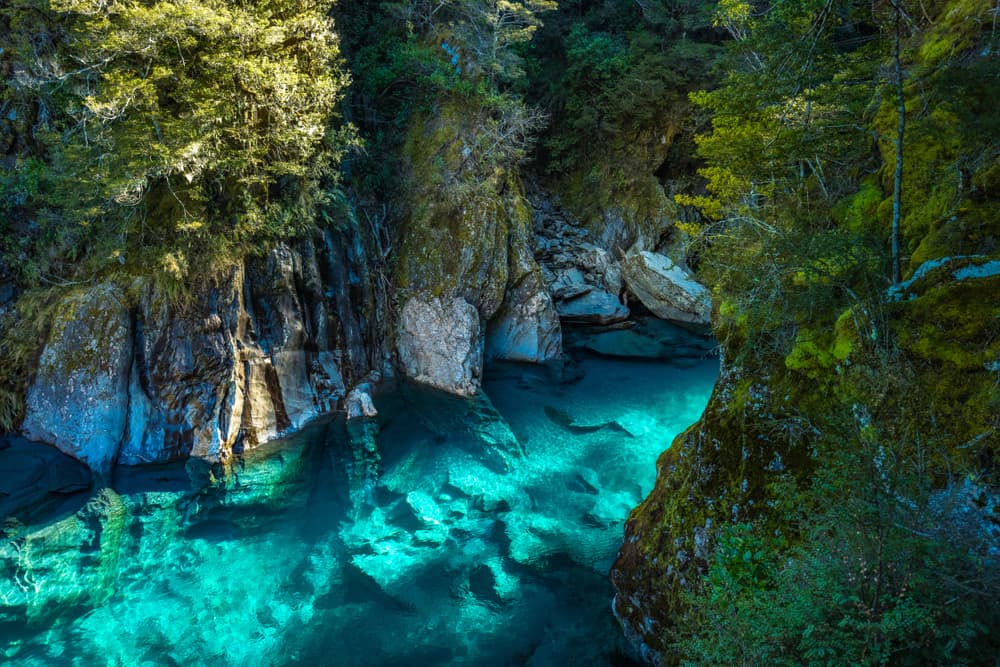
An hour north of Wanaka, the Blue Pools of Makarora offer basins of intense turquoise-blue, fed by glacial melt. Two suspension bridges, a beech forest, and crystalline water — for a striking nature stop on the way to Haast Pass.
Blue Pools lie in the Makarora valley, roughly an hour north of Wanaka, at the edge of Mount Aspiring National Park. These natural basins owe their intense turquoise-blue colour to the melt from alpine glaciers that feed the Makarora River. A short walk through beech forest leads to two suspension bridges overlooking crystalline waters, beloved by intrepid swimmers and photographers alike.
Practical information at a glance
- Access : From Wanaka, take State Highway 6 north to the Blue Pools Walk sign near Makarora. Free parking on-site.
- Time recommended : 1 to 1.5 hours return for the walk; allow more if you swim.
- Entry : Free.
- Water : Extremely cold year-round — glacial meltwater. Swimming is possible but not advised for those sensitive to cold.
- Dress : Hiking shoes recommended; swimwear if you plan to swim.
- Accessibility : Trail not suited for wheelchairs (uneven forest terrain).
What you'll see
The trail winds through a forest of red beech (Nothofagus fusca) before reaching two suspension bridges. Below, the Makarora River forms pools with striking blue-green reflections. The water's clarity allows you to see the rocky bottom several metres down. Rainbow trout sometimes swim in the currents.
History and context
The Makarora valley was a passage route for Māori crossing the South Island Alps to reach the west coast and its pounamu (jade) deposits. Haast Pass, nearby, was traversed by European explorer Julius von Haast in 1863. Today the site is managed by the Department of Conservation (DOC) as part of Mount Aspiring National Park.
Highlights of the visit
The suspension bridges
Two cable bridges span the river at different heights. Some visitors jump from the lower bridge into the pools — a practice tolerated but best assessed according to conditions and your fitness. Water temperature rarely rises above a few degrees above zero.
The beech forest
The trail itself deserves attention: the red beech canopy filters light and creates a dense forest atmosphere, typical of New Zealand's South Island Alps. Native birds like the fantail (pīwakawaka) often accompany hikers.
The colour of the water
The turquoise hue results from light scattering by fine glacial particles in suspension — the same phenomenon seen in Alpine glacial lakes. The colour is most vivid in bright sunshine, mid-day.
Photography tips
Mid-day light, when the sun is high, best reveals the blue colour of the pools. From the suspension bridges, a downward angle upstream captures both the water's transparency and the rocky bed. A polarising filter (or its digital equivalent) reduces surface reflections. In the forest, golden hour provides warm light on beech trunks.
Location and access
Blue Pools lie about 65 km north of Wanaka via State Highway 6, near the hamlet of Makarora. Parking is signposted on the road. No regular public transport serves this spot; a personal vehicle or organised excursion from Wanaka is necessary. The site is often combined with a stop at Haast Pass or the west coast.
Nearby
- Lake Wanaka — large glacial lake at the foot of the South Island Alps, starting point for many hikes.
- Mount Aspiring National Park — alpine wilderness designated a UNESCO World Heritage site, accessible from Wanaka.
- Haast Pass — spectacular alpine passage linking Otago to the west coast, with waterfalls and viewpoints.
- Lake Hawea — Wanaka's quieter neighbour, with deep blue waters.
Frequently asked questions
Yes, swimming is possible. The water is extremely cold year-round (glacial meltwater); bring swimwear and expect a significant thermal shock. Some visitors jump from the lower bridge, but assess conditions before attempting this.
The site is accessible year-round. Austral summer (December–February) offers the best swimming conditions and longest days. In winter, the forest is quieter but the water is even colder and bridges may be slippery.
The return trail takes roughly 1 to 1.5 hours at a leisurely pace. Allow more time if you pause for swimming or photos at the pools.
No, access to the trail and pools is entirely free. On-site parking is also free.
Easily. Blue Pools fit naturally into a route between Wanaka and the west coast via Haast Pass. Plan a full day to enjoy the pass's waterfalls and viewpoints alongside the pools.
The trail is short and relatively flat, accessible to children in reasonable fitness. Watch them carefully near the suspension bridges and banks, and discourage young children from swimming due to the extreme cold of the water.
Give it a go!
Our local experts arrange this activity for you.