Complete Guide to Driving in Nouvelle-Zélande
Driving in Nouvelle-Zélande is an experience that requires preparation.
Driving in Nouvelle-Zélande is an experience that requires preparation. Between driving on the left, local regulations and specific road signs, it is essential to know the Nouvelle-Zélande traffic code for a successful road trip! Discover our guide to navigate Nouvelle-Zélande roads, as well as our practical tips for obtaining a translation of your French licence (or an international licence) required for driving and car rental.
Can you drive in Nouvelle-Zélande with a French driving licence?
A foreign traveller can drive in Nouvelle-Zélande, provided they have a driving licence + an official English translation OR an international driving permit.
Note that the international driving permit will not be valid locally if you do not present your original driving licence.
One or the other are essential to drive on Nouvelle-Zélande soil, but also to rent a vehicle (car, motorhome, etc.). The only difference is the validity period. Here are the steps to obtain one of the two documents...
Request a translation of your national driving licence
The translation of your French licence (Belgian, Swiss, etc.) must be carried out by an approved translator, recognised by the Nouvelle-Zélande Ministry of Transport (Waka Kotahi NZ Transport Agency – NZTA). Several approved organisations offer this service: the list of driver licensing agents is available on the official NZTA website.
Translation fees range between €15 and €50 and the average time to obtain the document is three working days (or within 24 hours on an urgent basis, with an additional fee for expedited requests).
The validity of the translation expires at the same time as your national driving licence expiry date. But be careful, you can only drive for 12 months with a French licence and its translation in Nouvelle-Zélande. Beyond one year, you must request an international permit.
ℹ️ Note
According to the French government website, "the validity of the driving licence should not be confused with the validity of your licence categories. So even if your licence is only valid for 5 or 15 years, your category B licence allowing you to drive a car remains valid for life (except for individual restrictions, for example for health reasons)".
The driving licence is the format of your permit. It can be in the form of a "credit card" or 3-panel folding "cardboard pink" format.
The expiry date of the "credit card" format driving licence is shown on the front, at line 4b.
The validity of the pink licence remains valid until 19 January 2033.
Request an international driving permit
If you plan a stay of more than 12 months in Nouvelle-Zélande, you must have an international driving licence. Valid for 3 years, this does not require translation. The application is made in France in two steps.
Apply online on the National Agency for Security Documents (ANTS) website to complete a form.
Send your file by post, once your digital file has been submitted online.
The documents to be provided are:
Proof of identity (national identity card, passport),
Proof of residence dated less than 6 months,
A valid and in-good-condition national driving licence,
A passport-style photo dated less than 6 months (in digital or paper format).
Depending on the season, processing of your application can take time. To be sure to have your permit in time, it is recommended to apply at least six months before departure. The international driving permit is issued free of charge.
Be aware that in case of a police check, you face a €350 fine if you do not have one of the two permits (national licence + translation OR international licence).
Where and how to rent a vehicle in Nouvelle-Zélande?
Minimum age
Regardless of the licence type chosen, one or the other is essential to rent a vehicle. The minimum age to rent a vehicle in Nouvelle-Zélande is generally 21 years old, with a full licence held for at least 1 year.
Insurance
Young driver insurance
Some agencies allow driving from age 18 provided you take out specific insurance (approximately €10 additional per day of rental).
Car insurance
In theory, taking out car insurance when renting a vehicle in Nouvelle-Zélande is not mandatory. However, note that most rental agencies include this protection in the rental price – and it is highly recommended in case of accident or theft.
Note that additional insurance excludes any possible fines related to speeding or improper parking. The price of insurance varies depending on the options chosen.
💡 Tip
If you plan to explore the North Island and South Island in Nouvelle-Zélande: check with your rental agency that the vehicle is authorised to take the ferry – which is often the case, but involves additional fees when boarding.
Rental agencies
There are many rental agencies in Nouvelle-Zélande, including Europcar, Hertz and AVIS. Most chains have branches at airports and major cities, such as Auckland, Wellington or Christchurch. But also near bus or railway stations and tourist ports, such as Picton. Most of them allow vehicle return in a different city than the departure point.
Is it easy to drive in Nouvelle-Zélande (and what are the rules)?
Before taking the wheel in Nouvelle-Zélande, it is important to know the traffic code and the main traffic rules. A period of adjustment is necessary in the first few days, but reflexes come quickly. Here is a small guide to the essentials to know to drive stress-free in the land of the kiwis.
🚗 Tailor-made circuit for a Nouvelle-Zélande road trip...
Worried about getting the paperwork wrong or planning every step of your road trip?
Discover our Freedom circuit: 18 days to explore both islands by car!
Designed by our local agency, this itinerary allows you to explore the country's most beautiful spots on a road trip, with complete peace of mind. If you have any doubts or questions, do not hesitate to contact the Antipodes Travel team: our English-speaking team is here to support you.
👉 Access the Freedom circuit (18 days)
Nouvelle-Zélande traffic code
Driving is on the left and therefore, in any case, remember that your vehicle must always be on the left side of the road. For example, after turning right at an intersection, the vehicle should be on the left lane after the turn. Also note that the windscreen wiper and indicator stalks are reversed (except on some European models).
Road signs also require some vigilance, as many do not exist in France. To prepare yourself as best as possible, do not hesitate to consult the signs on the NZTA-Waka Kotahi official website.
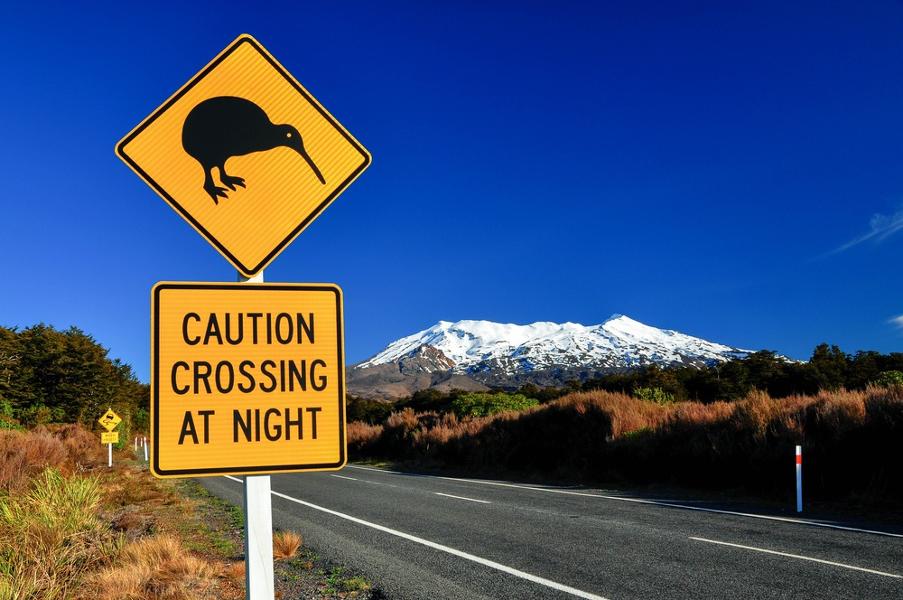
As a general rule, remember that triangular signs on a yellow background signal a hazard. It could be a bend or a pedestrian crossing, but also a warning of the presence of animals in the area. For example, it is not uncommon to see signs warning of penguins, kiwis or pukekos (endangered native birds). Amusing warnings, but to be taken seriously.
The speed limit is a little different from ours.
Motorways and national roads are limited to 100 km/h (90 km/h for motorhomes over 3.5t),
In built-up areas, speed is between 30 and 50 km/h (depending on zones in certain cities).
Nouvelle-Zélande drivers may find your driving a bit slow. In that case, do not worry. Simply pull over, when possible, to let them pass. Conversely, avoid accelerating sharply as soon as a straight stretch of road appears: local drivers often wait for this type of section to overtake safely!
Note also that speeding is severely sanctioned – as is the use of a mobile phone while driving.
Overtaking also requires some attention. Indeed, the majority of roads have only one lane in each direction of travel. To overtake, it is better to use dedicated zones called passing lanes. Note that the prohibition on overtaking is marked by a yellow line (the equivalent of our white line in France) and overtaking is always done on the right.
Traffic in roundabouts flows clockwise and overtaking is also done on the right. Do not worry, each entrance is equipped with a give-way sign, which makes merging easier. Simply watch your right and proceed when the road is clear.
Parking is also regulated. To park on a street, whether one-way or two-way, your vehicle must be parked in the same direction as your direction of travel, at the risk of receiving a fine or having your vehicle towed away.
If you are driving a motorhome, be aware that there are many dedicated parking areas (and free), as well as affordable spaces in campsites. Expect between 40 and 80 Nouvelle-Zélande dollars (€20 and €40) for a space with electricity.
One-lane bridges (one lane bridges) are fairly common in Nouvelle-Zélande, especially on the South Island. These can be announced by a Stop sign, a Give Way or traffic lights. In any case, it is strictly forbidden to stop on the bridge to admire the scenery or take photos.
Railway crossings also require great attention. Why? In Nouvelle-Zélande, many of them are not equipped with automatic barriers and are simply marked by a Railway Crossing sign!
When there is a barrier, the signalling is often supplemented by a Stop or Give Way sign. In either case, exercise extreme caution when approaching a level crossing.
Drinking and driving
Alcohol consumption is limited to 50 mg/100 ml of blood for those over 20 years old and completely prohibited for drivers under 20 years old. In case of infringement (driving under the influence of alcohol or drugs), you face severe penalties.
Traffic offences and fines
In 2025, the amounts of traffic offences are:
Speeding: €15 to €315 (depending on the excess),
Using a mobile phone while driving: €75
Not wearing a seatbelt (compulsory for all passengers): €75
Non-compliance with road signs: €75
Exceeding alcohol limit: the fine can reach €2,260 for a level of 80 mg/100ml.
Note that fines can be paid online on the Nouvelle-Zélande police official website.
Child car seat
If you are travelling with a child under 8 years old, they must be installed in an approved booster seat (car-seat) or until the child reaches 1.48 metres. This mandatory equipment incurs an additional cost when renting a vehicle (check with the agency for more details).
Winter driving
In winter, it is not uncommon to see snow and ice on the roads. To avoid problems, equip your vehicle with the required accessories! Also, always plan to have enough petrol; in case of closed roads requiring long detours.
What types of roads are there in Nouvelle-Zélande and are they well maintained?
National roads (State highways)
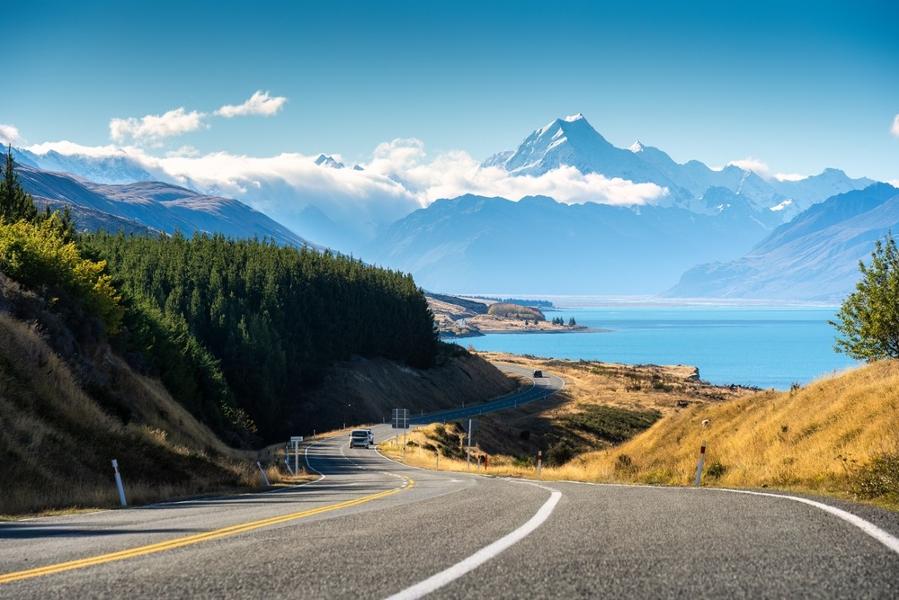
Contrary to what their name might suggest: State highways are not motorways. These are national two-lane roads, without a central reservation, with a speed limit set at 100 km/h.
These roads require great vigilance, particularly in winding areas (such as around Queenstown or Rotorua) where visibility can be very limited on bends.
It is even recommended to turn on your headlights during the day to signal your presence. Unlike some European countries, Nouvelle-Zélande drivers do not honk to announce their passage on mountain roads.
Secondary roads
There are two types of secondary roads.
Sealed roads: paved roads that allow two vehicles to pass each other without too much difficulty. These are fairly easy to navigate, in compliance with speed limits.
Gravel roads: gravel roads, very common in the backcountry (or to reach hiking trailheads). These tracks can be more uneven, with poor visibility, and yet the maximum permitted speed is often the same as on national highways! Adapt your speed and drive at a maximum of 50 km/h!
Motorways (Motorways)
There are only three toll motorways in Nouvelle-Zélande. These are all located on the North Island (and are inexpensive). These three roads are also the only ones where you will find traffic congestion during rush hours (around 8 am and 6 pm).
Northern Gateway near Auckland: a 7.5 km motorway located north of Auckland, between Silverdale and Pūhoi. Toll: €1.30
Tauranga Eastern Link: a 15 km expressway that connects the Domain Road interchange (near Pāpāmoa) to the Paengaroa roundabout (towards Whakatāne and Rotorua). Toll: €1.15
Takitimu Drive around Tauranga: a 5 km motorway that bypasses Tauranga city centre towards Tauranga port and Mount Maunganui. Toll: €1.05.
The amount is higher for some heavy vehicles, such as large motorhomes (around €2.80).
Limited to only 100 km/h (110 km/h for Tauranga Eastern Link), these three motorways are conducive to speeding… Our advice? Use a GPS with an audio alert, to avoid unintentional speed violations and fines.
A few free motorway sections allow a maximum speed of 110 km/h.
🧾 Motorways in Nouvelle-Zélande: zoom on tolls
Unlike French motorways, Nouvelle-Zélande tolls do not have a barrier with direct cash or card payment, and operate by scanning the licence plate via cameras.
Once you have travelled the section, payment is made, after the fact, online on the official website or at a physical location (such as some petrol stations). Tolls must be paid within five working days following passage, or you will incur additional fees. To pay, you can use a credit card or the POLi service (if you have a Nouvelle-Zélande bank account).
Some rental agencies offer prepaid packages or temporary passes. In this case, the toll is then billed directly to the agency.
This option is chargeable (a few dollars extra on your initial invoice), but allows you to enjoy your trip fully without worrying about payment formalities.
Discouraged (or prohibited) roads
Note that some roads cannot be used by rental vehicles for insurance reasons. This is the case, for example, with the famous Ninety Miles Beach (also called Te-Oneroa-a-Tōhē).
This "road" is actually a long beach, which allows you to reach Cape Reinga, at the northernmost point of the country. However, this road is, most of the time, not permitted by rental agencies – each rental company informs its customers of prohibited or dangerous routes when handing over the vehicle keys.
What type of vehicle should you rent to drive in Nouvelle-Zélande?
To navigate Nouvelle-Zélande roads (often winding and featuring elevation changes), it is recommended to choose a vehicle that combines comfort, good road handling and moderate fuel consumption.
The car
Ideally, a recent compact hybrid SUV that is easy to drive and manoeuvre in urban and rural areas.
For example, a Toyota Corolla Crossover model (or equivalent) allows you to drive on both country roads and paved roads – and cover long distances without consuming too much fuel (preferably 91 unleaded).
The van or motorhome
If you rent a van or motorhome in Nouvelle-Zélande, you will need, as with a car, your French category B licence and its English translation (or an international licence). In France, the category B licence allows you to drive cars, as well as vans and small motorhomes with a total weight not exceeding 3,500 kg.
Be aware that since 2024, Nouvelle-Zélande has tightened its wild camping rules (due to a sharp increase in tourist motorhomes and incivility, such as waste abandonment in nature...).
Now, to practice free-camp in unmanaged areas: a motorhome must comply with the NZS 5465 standard and obtain the green "Self Contained" sticker. This ensures that the vehicle has its own water supply autonomy (for several days) and a hermetically sealed waste container.
This green sticker has a cost, which is reflected in the rental price of a self-contained and equipped motorhome. Expect approximately €75 additional per day of rental.
⛽ Zoom on the price of petrol in Nouvelle-Zélande
1/ The price of fuel in Nouvelle-Zélande is generally cheaper than in France and prices are almost identical across all regions.
In August 2025, average fuel prices hover around:
98: €1.45/litre
95/96: €1.45/litre
91: €1.30/litre
Diesel: €0.91/litre
Note that most rental cars run on premium unleaded, 95/96 or 98, while 4x4s or motorhomes run on diesel.
2/ While most stations are open 24/7, note that those located in rural or remote areas may be closed all weekend.
Note: amounts in euros have been calculated from amounts in Nouvelle-Zélande dollars.
FAQ - All your questions
Driving on the left requires a short period of adjustment, especially regarding habits at intersections and roundabouts, which require looking to the right – not to the left. To help you, keep in mind that you drive clockwise (and drive on the left lane in bends). If you are travelling as two, the passenger can also be a co-pilot, who can guide you and help you exercise extra caution.
Driving in Nouvelle-Zélande is not particularly dangerous. The main danger is fatigue. To cope with long distances and remain vigilant on winding roads, it is recommended to take regular breaks – ideally, a 15-minute break every two hours.
Nouvelle-Zélande's main roads are generally well maintained. The NZTA agency (NZ Transport Agency Waka Kotahi), responsible for the majority of roads, implements, each summer, a vast resurfacing programme covering up to 10% of the road network. However, some secondary roads may present potholes.
There is no specific insurance for a road trip. When renting a vehicle in Nouvelle-Zélande, basic insurance is generally included in the package. However, this cover often has a high excess. To reduce this excess, it is recommended to take out Collision Damage Waiver (CDW) insurance. Although CDW is not mandatory, it is often required or included in the package and allows for lower costs in case of damage.
Frequently asked questions
Yes, you can drive in Nouvelle-Zélande with your French driving licence, provided you present it with an approved English translation. This translation must be carried out by an organisation recognised by the Nouvelle-Zélande Ministry of Transport (NZTA). This option is valid for stays of up to 12 months. Beyond that, you must hold an international driving permit.
The rental price varies depending on the type of vehicle, season and agency chosen. For a self-contained motorhome with the 'Self Contained' sticker, expect approximately €75 additional per day compared to standard rental. Insurance is often included in the price. For drivers aged 18 to 21, young driver insurance is required (approximately €10 additional per day).
A short period of adjustment is necessary, especially in the first few days. Reflexes generally come fairly quickly. The main trick: always keep in mind that your vehicle must be on the left side of the road, even after turning at an intersection. Also note that the windscreen wiper and indicator stalks are reversed on most vehicles.
There are 3 toll motorways in Nouvelle-Zélande, all located on the North Island: Northern Gateway (€1.30), Tauranga Eastern Link (€1.15) and Takitimu Drive (€1.05). Tolls operate by automatic number plate reading. Payment is made online on the official website within 5 working days following passage. Some rental agencies offer prepaid packages to simplify the process.
In Nouvelle-Zélande, the legal blood alcohol limit is 50 mg/100 ml of blood for drivers over 20 years old. For drivers under 20 years old, driving under the influence of alcohol is completely prohibited (zero tolerance). In case of breach, fines can reach €2,260 for a level of 80 mg/100 ml.
Yes, if you are travelling with a child under 8 years old or measuring less than 1.48 metres, the use of an approved booster seat (car-seat) is mandatory. This equipment can be rented directly from your vehicle rental agency for a daily fee. Check with your rental company before you leave.